
|
The
OSU Excavations at Isthmia - 1993 Preliminary Report
Fieldwork at Isthmia
sponsored by The Ohio State University took place from May 3 to
September 11, with most activity between 27 June and 14 August.
Thanks are due to Mrs. F. Pachygianni and Mrs. Z. Aslamatizdou of
the Fourth Ephoreia of Classical Antiquities and to Mr. Ioannis
Daglis of the Department of Conservation of the Ministry of Culture,
for unfailing support and encouragement.
Our primary
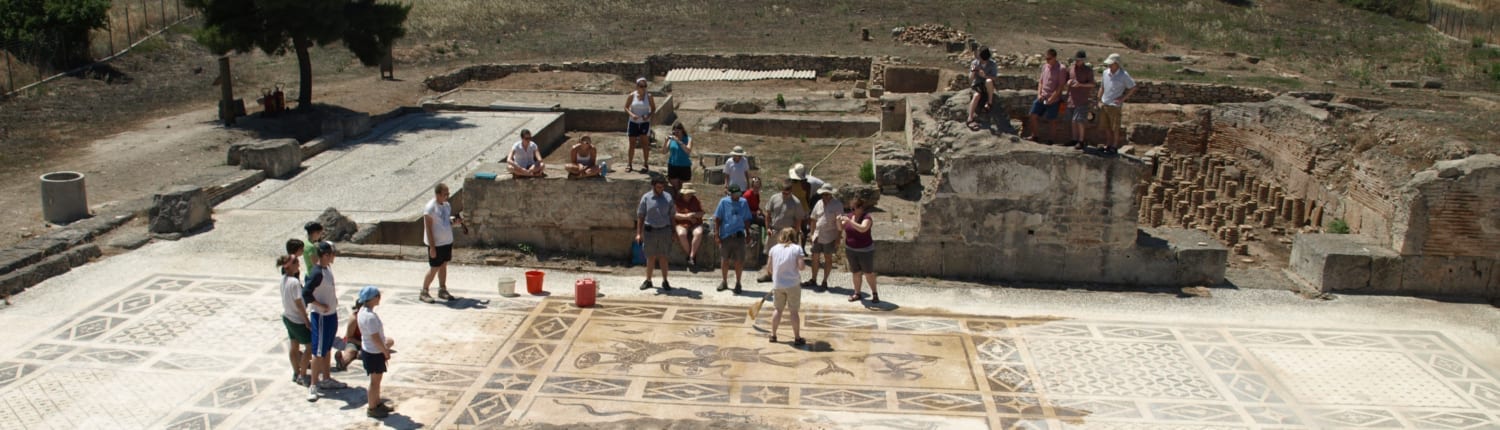
focus this year was the continued conservation of the monochrome
mosaic in the Roman Bath, discovered in 1976 and lifted in 1990.
Relaying of the mosaic began in 1992 and 21 of a total of 148 sections
were put back in their original places. Conservation this year began
on May 17 and continued until June 14, with an additional two weeks
of conservation in mid-August. This work was directly supervised
by loannis Daglis, with the assistance of Vasilis Marinos of the
Fourth Ephoreia and technicians from the Department of Conservation.
Work this year proceeded rapidly and a total of 48 sections were
re-laid, bringing the total in two seasons to 69 sections, and allowing
us to reach the middle of the mosaic. A particularly time-consuming
aspect of this conservation is the relaying of a single line of
tesserae between each of the sections; the new hardened mortar has
to be chiseled out, the tesserae properly selected and often cut
to size, and these then carefully set in a line that completely
conceals the joint between restored sections. Conservation work
proceeded rapidly this year and we hope that the task of relaying
the whole mosaic may be completed during the 1994 season.
Reaching
the middle of the mosaic, 1993.
Further fieldwork
was carried out in the area of the Roman Bath, where we cleaned
out several trenches excavated in previous years. Most notable was
trench GB 70-1/93-2 located just north of the north wall of the
Bath. This trench had been excavated to a depth of over 4 m. below
the modem ground level and it exposed a sequence of collapses that
are clearly visible in its west scarp. This scarp was carefully
photographed and drawn and material from the 1970 excavation was
examined to provide chronological information. At the top of the
scarp was a large collapse, involving large blocks, that sloped
down gradually from south to north; this collapse is dated by pottery
of the 7th century after Christ and seems to represent a significant
abandonment of the Hexamilion fortification at that time. Below
this upper collapse was a hard-packed level that appears to represent
ground-level at the time the Hexamilion was constructed in the early
years of the fifth century. Below this was another series of sloping
fills that included enormous quantities of marble chips and mosaic
tesserae and debitage; the tesserae were similar to those found
in the mosaics on the floors of the Roman Bath. Surprisingly, however,
this material was found in a context dated by pottery that may be
assigned to the middle and latter years of the third century after
Christ. On the basis of the slope of these fills, this material
must have been thrown from the top of the north wall of the Bath,
suggesting that the roof of the building must have been removed
(and presumably repaired) at that time. This provides an interesting
and otherwise undocumented event in the history of the Roman Bath.
At the bottom of these sloping fills is another horizontal level,
dating to the middle of the second century and representing ground-level
at the time the Roman Bath was constructed. Finally, below this
level were two east west walls, roughly parallel to the north wall
of the Roman Bath. One of these (the northern of the two) was apparently
standing at the time the Bath was constructed, although it had been
dismantled by the time the third-century sloping fills were deposited.
The southern wall, by contrast, had no connection with the Roman
Bath and its foundations had already been covered by soil at the
time the Bath was built. There is presently no evidence about the
building to which this latter wall belonged although it is tempting
to suggest that it could have been part of the Greek-period bathing
establishment, whose remains are visible further to the south.
Investigation
this year was begun in the area of the so-called East Field, located
east of the Temple of Poseidon and west of the Byzantine Fortress.
This area had been excavated between 1970 and 1972 by Paul Clement
but he had been unable to prepare a final report on those excavations.
We therefore began a program to study all the architectural features
and context material (pottery and other finds) from this area. The
East Field contains a veritable maze of walls of poor quality, clearly
representing more than one period of construction. These walls seem
to be from small buildings (houses or other small establishments)
with facilities for water and the preparation of food. The earliest
of the walls seem to date from the second century after Christ,
although most of the ceramic material appears to date from the third
century and later. In all, there are objects from over 700 individual
stratigraphic units in approximately 30 trenches. Of these we were
able to examine and analyze approximately one-third this season.
It is premature to speculate about the purpose and history of this
fascinating area, although research in subsequent years will surely
lead to important conclusions.
In addition
to these investigations, we continued study of the architecture
and finds in the area of the Roman Bath. Progress toward publication
of this important monument is well under way, under the supervision
of Jeanne Marty (University of North Carolina at Asheville), Fikret
Yegul (University of California at Santa Barbara), and Timothy E.
Gregory (The Ohio State University). Architectural documentation
of the Bath neared completion with the execution of some eleven
elevation sections through the building and a composite drawing
of the features of the Greek Bath, whose remains lie under the Roman
structure.
Timothy E. Gregory
September 1993
|