
|
What
Is Excavation?
Excavation
is the most time-honored archaeological tool for understanding
the processes of the human past, and it certainly represents the
type of activity that most people attribute to archaeology. As
a definition, excavation is simply the controlled exploration
of what lies below the surface, usually carried out systematically
in gridded trenches with shovel and trowel. It is often slow and
tedious work which involves digging down a centimeter at a time,
but can also be backbreaking, difficult toil, shoveling through
meters of densely packed soil. But the purpose is the same in
either case, to reveal the types of human activities that took
place at a site over time. Through the process of excavation,
archaeologists look backwards into time, examining an area at
discrete temporal periods. Excavating a few centimeters down may
reflect the material culture of the 1800s while several meters
may uncover artifacts from ancient times. Researchers can use
the incomplete material record to reconstruct the cultural history
of the place at particular points in time.
Locating
Sites
The
visible remains of the ancient past do not normally lie exposed
on hilltops or in the open desert. The Parthenon in Athens
and
the Egyptian pyramids are the exceptions and not the norm (Figure
8.1). More commonly, archaeological sites are buried beneath
the
surface and may be partially or totally invisible to the eye.
How then do archaeologists even locate sites given such a situation?
In the olden days of classical archaeology, explorers used
ancient
literary references to place names as guides in locating lost
cities. For example, Heinrich Schliemann relied on literary
references
from Homer, his own hunches, and a little luck to find the ancient
cities of Troy and Mycenae. In addition, many ancient places
(for
example, Athens, Mycenae, Sparta) have kept their ancient names
unto the present, making it clear where - in a general sense
-
the ancient places were.
Apart from
this traditional method, however, archaeologists today use a variety
of heuristic tools in locating sites. Systematic surface survey
(discussed in the next section) reveals the variety of materials
present across a region, provides information about what activities
may have taken place there over time, and suggests the different
cultural components represented. Artifact scatter patterns reflect
the location of subsurface structures and are used to guide archaeological
excavation. When structures are wholly invisible on the surface,
researchers can employ the recent advances in archaeological technique
to locate sites. Remote
sensing, which includes aerial photography and satellite imagery
of an area, may accentuate subtle differences in landscape that
are outside the spectrum of visible light, thereby suggesting
subsurface buildings and features (Figure 8.2). A dark soil stain
on an aerial photograph may indicate the rich organic material
of an ancient trash midden. Because the state of vegetation depends
on soil fertility, abnormal crop marks may suggest underground
walls, ditches, and roads. Slight nuances in shadow may point
to elevation differences and ancient structures. Computers are
now used to detect these subtle differences. Archaeologists can
examine the pixel shapes and forms of known structures (e.g.,
temples) on digitized photographs and try to relate these to similar
spectral emissions on the photograph of the survey area. Other
projects have utilized geophysical prospecting devices to reveal
more about the use of the area. A team may use resistivity meters
to discover the soil's resistance to electrical current and magnetometers
to detect variation in the magnetic properties of the soil. These
tools reveal subsurface soil anomalies which often represent ancient
features such as walls and trash middens. Techniques are now so
sophisticated that if the buried structure is well preserved,
a team might be able to create a reliable plan of the invisible
feature. If an excavation phase follows, this will certainly help
guide the placement of test trenches and excavation grid.
These advances, along
with continual chance discoveries through modern construction, ensure
that there is never a shortage of researchable sites and little need to
"go looking" for cities, treasures, and pretty things. Additionally, modern
archaeologists seldom excavate sites to find what is there. More often
than not, the research questions and objectives guide the choice of what
and where to excavate.
Planning
and Logistics
The excavation
of a site is a tremendous endeavor and the obligations to publish
the results encourage careful forethought about the direction
the project should head and the particular issues to be addressed.
Basic logistical questions have to be considered. How many people
will be involved? How much money and other resources are available
to the project? At what scale will excavation be carried out?
In planning an excavation project, many institutions formulate
a research design, the overarching goals and plans of the project.
It is principally the job of the director(s) to consult with others
on the project and develop such a plan.
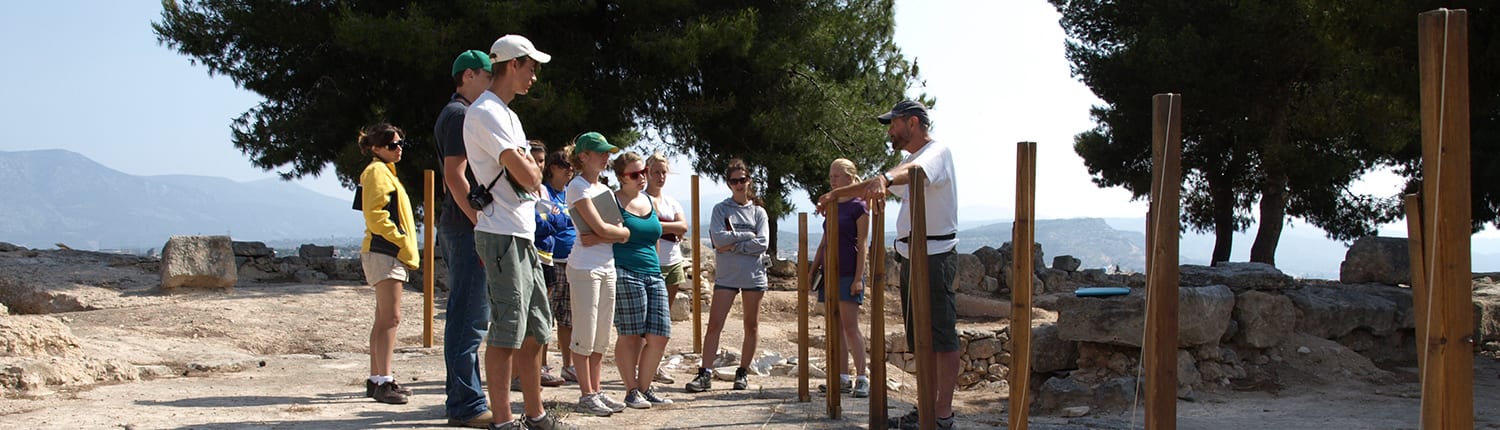
The
size and scope of archaeological excavation and the field team
depends upon the resources and funds available, ranging from a
small team of volunteers to a network of paid professionals, workers,
and supervisors under the guidance of a project director (Figure
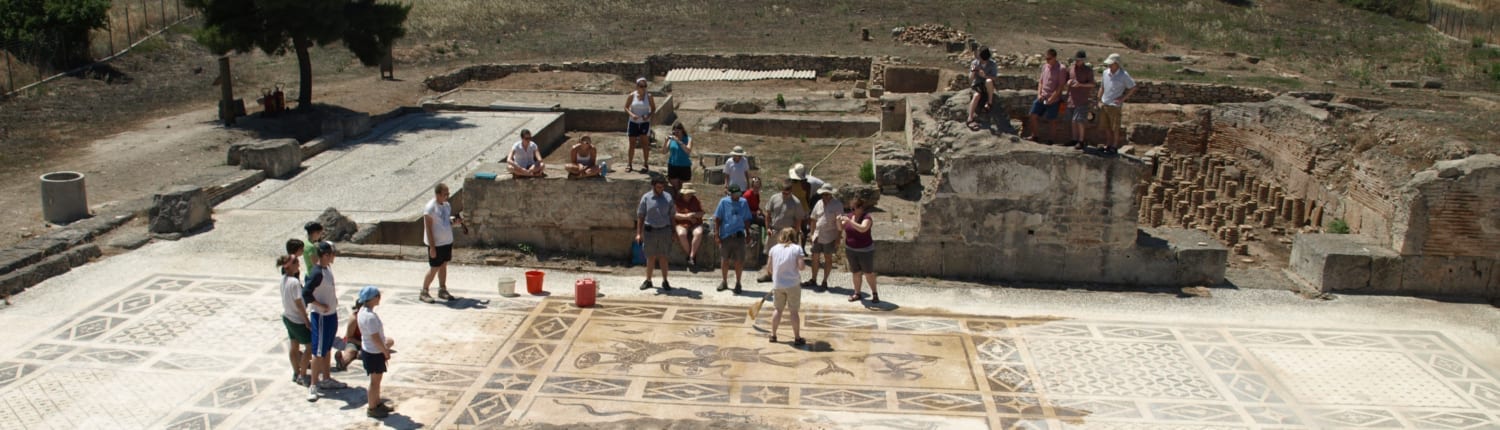
8.3). At Isthmia, where excavation has been conducted continuously
for half a century, the complexity of work necessitates a high
level of organization. Many field archaeologists and students
with various backgrounds visit the site every summer to participate
in a unified effort to recover and analyze information about the
past. The directors provide an overarching plan and oversee all
work but it would be impossible to carry out the demands of fieldwork
without the help of project coordinators, team leaders, volunteers,
and specialists. A project as complicated as the Roman Bath at
Isthmia, for example, requires people with technical skills in
botany, geology, computers, cartography, as well as special knowledge
of certain periods (e.g., Roman, Greek) and areas (e.g., architecture,
pottery).
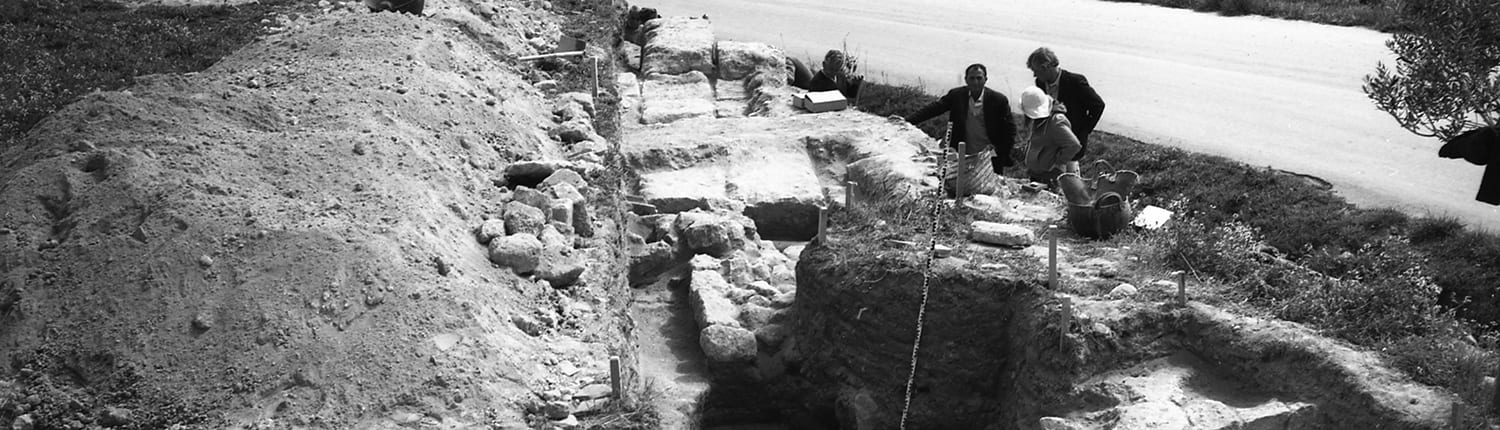
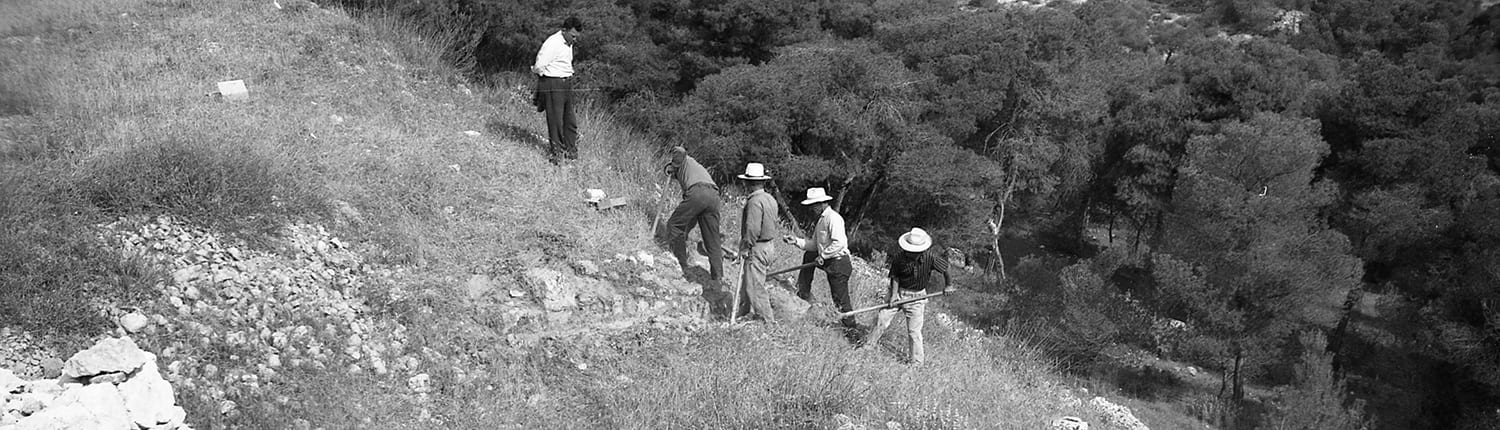
During
the planning stage, it is important that the director decide what
and where to excavate. Excavation is tedious, time consuming,
and expensive, and it is rarely feasible or possible to expose
an entire site (Figure 8.4). Nor would it be wise to dig a whole
site since archaeological technique will continue to improve and
future scientists will be able to do more with the data than is
possible now. Because of this, most projects employ a sampling
strategy to select areas within the site grid which should reflect
the whole site. This can be either completely random, systematic
at set intervals (e.g., one trench every 10 meters), or predicated
based on the research design. In classical archaeology, this "predictive"
approach is most commonly used, since it allows archaeologists
to focus on areas where they think they will find information
to answer their basic questions. Moreover, projects may decide
to sample only a proportion of the archaeological material within
each trench. But all these decisions should be made before excavation
ever begins.
Archaeologists employ
a great variety of equipment to carry out a scientific excavation.
The tools used will depend upon the nature of the project goals,
time constraints, and the manner of excavation. Most projects
use shovels, picks, and trowels, but it is not unheard of to also
use bulldozers and heavy equipment to find walls or strip the
first layer of soil away in search of features. Heavy equipment
is sometimes still used in special circumstances today but this
is not the norm. Consider the typical tool list for Ohio State's
excavation:
|
Setting
up a Grid
|
Excavation
|
Processing
and Storage
|
- Compasses
- Transit
and tripod
- Dumpy
Level
- Theodolite
- Stadia
Rods
- Sledge
hammers
- Datum
pipe
- Wooden
stakes
- Chaining
Pins
- Measuring
Tapes
- Stick
Tapes
- Calculator
String
- Nails
-
Line Levels
- Magnifying
glass
- Plumb
bob
- Magic
markers
- Machete
and sickle
- Gas-powered
weed eater
-
Pocket knife / razor blade
- Map
|
- Picks
- Shovels
and Spades
-
Skimming Shovels
- Hoes
- Trowels
- Brushes
and brooms
-
Dustpans
- Wheelbarrow
- Buckets
and Zembilia
- Tote
Bags
- Gloves
- Shaker
Sifters
- Field
Notebooks
- Rulers
(Straight Edges)
-
Clipboards
- Map
Paper
- Tarps
- Water
Jugs
- Cameras
- Munsell
Color Book
|
- Washing
Buckets
- Dental
Picks
-
Tweezers
- Drying
Trays
- Screens
and Sieves
-
Toothbrushes
- Plastic
Bags
- Paper
Bags
- Paper
Tags
- Storage
Boxes
- Scales
- Rubber
bands, tacks, tape, scissors
- Writing
utensils
- HCl
|
The
Spatial Dimension
Modern
archaeology is scientific and systematic in its approach to vertical
and horizontal space. Since the end goal of research is always
to interpret the data in meaningful ways, spatial control is essential
to any excavation. The degree of spatial control varies according
to the goals and resources of the individual project. An agency
contracted to do salvage work before an area is bulldozed will
have significantly less time for precision than archaeologists
who return to the same site on a yearly basis. But in either kind
of project, archaeological material is recorded in terms of its
matrix, provenience, and association with other artifacts. The
matrix is simply the physical (cultural or geological) medium
in which artifactual material is found (i.e., normally it is the
soil in which the material is located), while the provenience
is the specific three-dimensional location of the material within
that matrix. Two or more artifacts found together are said to
be in association (Figure 8.5). The only meaningful way to interpret
the archaeological record is by understanding artifacts in their
spatial context.
The most common
way of establishing spatial control at an archaeological site
is by the imposition of 3-dimensional horizontal and vertical
grid. The grid can be actually laid out, using strings or tape,
or it can be more notional. All points in a grid are related to
a datum, a reference point of known horizontal and vertical location.
Usually, archaeologists will designate this point with a semi-permanent
marker such as a wooden stake, a spike, or a metal pipe. The datum
may be assigned an arbitrary grid reference value such as 0,0
and an elevation such as 100.00 meters (above sea level, often
referred to as AMSL, "above mean sea level"), numbers
which do not correspond to true elevation and geographical location
but nonetheless are points of reference for the site. Moreover,
it is possible, though more difficult, through the use of a handheld
GPS unit (which tracks one's position in relation to satellites)
or a topographic contour map to link the datum to an actual location
and a true elevation; actual location will normally be based on
longitude and latitude or, more commonly, a national or regional
grid, often based on the so-called UTM system.
After the
datum point has been chosen and given a value, a physical grid
is often created over the entire area of examination. Using telescopic
equipment such as a transit, a dumpy level, or a "Total Station"
(similar to the other two, but done with infrared light beam and
an internal computer), a crew shoots a baseline from the known
datum point, plants stakes or nails into the ground at set intervals
(e.g., every ten meters), and then triangulates other points off
this baseline. The stakes are then strung to create a visible
grid across the site; seen from above, the area appears as a series
of squares of consistent size (e.g., 10x10m). The corners of the
squares are assigned values relative to the datum. Thus, a point
with the coordinate value 55N, 32.5E and an elevation of 125.78
m., lies 55 meters north, 32.5 meters east, and 25.78 meters above
our hypothetical datum. The value of this system is that every
point within the boundaries of the grid is known in relation to
every other point and all artifacts can be recorded in spatial
terms.
Sedimentation
and Stratigraphy
The
remains of sites today rarely know the sunlight of the surface.
Thousands of years of environmental and human processes have buried
ancient civilization under meters of earthen material. Ancient
buildings collapsed and were covered over either by new construction
or silts deposited through natural activities such as erosion
and mudslides. All these immediate and long-term processes left
their marks on the archaeological record through discrete layers
of earth (called strata) that built up over time (Figure 8.6).
The guiding principle in all scientific excavation is stratigraphy,
the study and interpretation of strata (layers) in order to understand
the historical processes of site formation. Excavation by strata
provides not only a meaningful methodological tool for managing
vertical and horizontal space but also a conceptual framework
for understanding the geological, environmental, and cultural
history of the site. Stratification is the long-term buildup of
sequential layers of earthen material through human and geological
activities. Because the processes of sedimentation change at different
points in the history of a site, discrete deposits of organic
and geological composite will form which vary in soil composition,
color, texture, thickness, and associated cultural material. Thus,
the excavation will encounter different "layers" at
various elevations under the surface. It is the task of the archaeologist
to distinguish these layers at the time of excavation, a problematic
and difficult exercise since strata fade into each other and are
rarely completely distinct.
Because each stratum
resulted from specific kinds of depositional processes at work over a
restricted period of time, it is possible to chronologically relate the
position of one layer to another. According to the law of superposition,
since sedimentary layers accumulate upward through time, the oldest layers
will always be the lowest vertical levels, while the most recent layers
will be the highest vertical levels. This rule is not without its exceptions.
Secondary processes such as erosion, earthquakes, floods, burrowing animals,
and human activities sometimes redeposit and mix strata. For example,
the digging of a pit and the redepositing of the soil often create a messy
situation called reverse stratification where the most recent material
lies below the older material. Nonetheless, if we can assume that generally
a layer was deposited more recently than the layers below it, it follows
that the archaeological material found in the layer was also created more
recently. In this way, strata are useful in establishing a relative chronology
for a site.
Strata
represent a discrete period of time and so artifacts within the
layer can be used to date the entire layer. Artifacts from the
same layer are assumed to represent the same period of deposition
and to have entered the layer at the same time; generally, the
most recent artifact dates the entire layer. At Isthmia, for example,
a layer that contained 8 Classical Greek potsherds and 2 Late
Roman potsherds would receive a Late Roman date (because the Roman
period is chronologically later than the Greek period). Although
there may be earlier material, the later artifacts still provide
the date of deposit for the layer. When the artifact is an inscription
or coin, a date of some precision can be assigned to the layer,
and in many Mediterranean regions, pottery (which changes stylistically
through time) can also be an effective means of dating the layer.
So-called "scientific" (absolute) dating techniques
are generally not used in classical archaeology, as they are in
prehistoric archaeology, since they commonly provide less precise
dates than the relative dating of artifact types. For example,
certain pottery styles for some periods are restricted to 25 years,
while a radiocarbon date may represent a period of one hundred
to two hundred years.
In fieldwork
at Isthmia, the basic stratigraphic unit and archaeological context
is called a "Basket" and corresponds to a three-dimensional
area of excavation. (This term comes from the fact that in the
past all the material from a single layer was put in a wicker
basket - and the name has continued to be used!) All soil in a
Basket is considered to be part of the same depositional processes,
and all material (artifacts, floral and faunal remains, soil)
presumably entered the layer at the same time. When crews observe
a visible change in the excavation layers while digging, the current
Basket is closed and a new Basket is opened and assigned its own
number. Later, if successive Baskets (such as 7 and 8) are considered
to represent the same layer, they can always be combined. This
ability to later combine Baskets allows careful treatment of subtle
differences in soils that may or may not reflect two different
layers. But of course the opposite is not true: once a Basket
has been dug, it cannot later be subdivided, so care and a tendency
to divide Baskets in excavation is a wise policy.
Recording
Excavation
Archaeological
excavation is inherently destructive because it permanently removes
both artifacts and the surrounding soil matrices from their original
context. Artifactual material cannot simply be put back into the
ground, and what remains in the way of notes, photographs, memories,
and drawings provides the only tools to "reconstruct"
the trench. Therefore, responsible and accurate recording is the
most essential component of any project, and excavation is meaningless
without written and visual records.
Most
projects use preprinted forms and notebooks to record the process
of excavation. The forms provide a standard means
of dealing with information about finds, features, excavation,
photographs, and stratification; this in turn ensures consistency
between different trench supervisors in the kinds of information
collected and permits easy transformation of the data into
a digitized
format. The field notebooks are the principal means of recording
the process of excavation. Detailed narrative includes information
about the conditions of excavation such as the nature of the
matrix,
the personnel present, the methods employed, amount of soil removed,
and the weather. More basic observations are recorded about
type
and quantity of artifacts found in trenches, features and their
extent, faunal remains, and stratigraphic units. This is always
in juncture with spatial location data (elevation, horizontal
spread) so that in layer analysis the archaeologist can reconstruct
when and where artifacts began to appear. At Isthmia, the trench
supervisor keeps a notebook recording the process of excavation
for the trench. In a typical season, the Isthmia project will
fill up multiple notebooks recording the excavation of various
areas under research. Ohio State University Archaeological
Projects
in Greece have been involved in nearly two dozen of these areas
in the northeast Peloponnesos over the last two decades. At
Isthmia
itself, areas include (among many) the Byzantine Fortress, the
Northeast Gate, and East Field; most recently, efforts have
focused
on the Roman Bath. In previous years notebooks were identified
by the year and the initials of the excavator (e.g., 78 JMP);
in more recent times the notebooks which record this research
are numbered sequentially 01, 02, 03. Usually, notebooks describe
the excavation of one area:
|
Notebook
|
Area |
|
01
|
Northeast Gate |
|
02
|
Roman Bath, Room
VI, Trenches 1-3 |
|
03
|
Roman Bath, Room
VI, Trenches 4-7 |
Spatial data
forms the basis of the recording system, and all objects, drawings,
and photographs are linked back to their primary context, a spatial
location within a 3-dimensional grid. At Isthmia, the "Lot"
is a concept used to link spatial data with an object, context,
or record. At Isthmia a Lot is essentially a Basket that has been
processed and studied in a preliminary fashion. A Lot number has
three basic parts. The first part is a number corresponding to
the year of excavation, shortened to the last two digits (e.g.,
1967 is 67). The second number represents the notebook in which
the Basket was described and this can be related to information
about both the Area of excavation and the Trench within each area.
The third number designates the Basket, the basic stratigraphic
unit of excavation (see above), which is described in the excavation
notebooks for each trench. Thus, the lot number breaks down as
follows: Year - Notebook - Basket. Lot 78-JMP-005 denotes Basket
5 in Jeanne Marty Peppers' notebook of 1978. More recent notebooks,
as we have seen, are numbered sequentially, and their Lots simply
record the Notebook and Basket. Thus, Lot 01-005 is Basket 5 from
Notebook 1, and when we look at this first notebook, we see that
it records the excavations of Trench 7 in Room VI of the Roman
Bath, carried out in 1990. This is a resourceful way to link any
object back to a spatial context. Other excavations have systems
that use different terminologies although the basic principles
are the same.
The
recording and excavation process is described in its entirety,
in the notebooks and in weekly reports of excavators, beginning
with an assessment of the area around the trench to be excavated.
Previous excavation in the area (complete with citations to earlier
notebooks), surface elevations, locations of datum points and
plans for the trench, sampling strategies, sifter screen size,
location of the backdirt pile -- all these should be noted before
digging begins. At Isthmia, the surface elevation is measured
at five different points of the trench prior to excavation, ensuring
that the slope of the ground can be reconstructed later. Excavation
itself proceeds slowly. Soil is removed with pick, shovel, and
especially trowel, the hallmark tool of the archaeologist. A trowel
allows excavators to remove soil from a trench a few centimeters
per scraping, thus affording maximum sensitivity in determining
the end of one stratum and the beginning of another. Because discrete
layers are treated differently, the crew must remain constantly
aware of slight differences in soil texture and color that signify
a new stratified deposit. A new deposit necessitates a new Basket
designation as well as careful descriptions about the layer, including
the associated artifacts, estimated date, and the reason for assigning
the new basket. The layer should be described in terms of soil
texture, composition, hardness, color (Munsell), and associated
natural material (e.g., pebbles).
After
a stratum has been fully excavated, the floor and walls are
scraped
clean and prepared for photography and sketching (Figure 8.7).
Spraying the surface with water at this point will delineate
features since decayed wood and charcoal often retain water
longer than
the surrounding soil matrix. Photographs are taken of both sides
and bottom of the excavation, and corresponding sketches made.
It is a daunting but important task for archaeologists to convert
what they see in the trench to a drawing format called a plan
view and elevation view. The plan view is a sketch of the bottom
of the excavation (at any moment) as seen from above (Figure
8.8).
Plan views delineate the horizontal extent and shape of features,
artifacts, and strata to each other, complete with a scale,
legend,
and a key for each distinct stratum and feature. It is also desirable
to draw and photograph artifacts in their original context
on
the excavation floor (in situ) since this is the surest proof
that the artifacts did not fall into the trench during the
excavation
process and contaminate the layer (Figure 8.9). Archaeologists
triangulate or measure from known coordinate points to map
any
object uncovered within the confines of the trench. Stakes or
nails of known elevation (usually outside of the trench) are
used
to ascertain elevations for the trench floor. These elevations,
along with color Munsells, and plotted artifacts, will also
be
included on the plan view. Moreover, the side walls (scarps)
are
"cleaned" to create profile drawings (or "scarp" drawings).
These are scale drawings of site stratification within a trench,
that are best seen in vertical cross section. A scarp drawing,
complete with elevations, key, and Munsell indicators, serves
as a check upon the excavators' interpretations of a site's stratification.
Thorough notes
are also made about the processing and sampling of archaeological
material during excavation. Because processing will vary according
to research goals, it is essential to record the procedures in
detail in order to determine how representative are the finds.
At Isthmia, for example, not all soil removed from a stratigraphic
layer during excavation is sifted; some soil is preserved for
later analysis while some is simply discarded. In Mediterranean
archaeology, because of the size of excavations and great quantities
of artifacts found, it is simply impossible to process all material.
Rather, excavators decide beforehand a set percentage of earthen
matter to sift (e.g., 50%, 1 out of 2 buckets) and discard the
rest. Moreover, even this sieving preserves only a sample of all
artifacts in a trench, as artifacts smaller than the holes of
the sieve are lost. The larger artifacts recovered in the sample
are placed in small cardboard boxes or bags, with attached tags
that note the lot number for the basket. A small sample of earthen
material is "water sieved" through a finer mesh (1/16 inch) to
ascertain the environmental history of the site. The soils wash
through the screen but the organic material--usually seeds, charcoal,
and animal bones - float to the surface and remain to be carefully
sorted out with tweezers and dental picks. As discussed in a later
section, all this material is analyzed back at the excavation
house.
Artifacts
found during the processes of excavation are regularly sketched
into the field notebook at the time of excavation or formally
drawn to scale on graph paper. At Isthmia, it is not possible
to draw and photograph all the finds and so artifacts that
seem
representative or unusual (imported artifacts, coins, etc.) are
drawn and catalogued (Figure 8.10). These drawings and pictures
are often published so that other archaeologists know what
has
been found at Isthmia and so parallels can be made at other sites.
Crews also
supplement drawings with photographs of basket floors, profile
walls, and in situ artifacts and features. Black and white,
as well as color photos, are often better visual records than
sketches and will certainly clarify plans and drawings. A project
may use photo inventory sheets including information about aperture,
shutter speed, and a description of the photo. At Isthmia, small
contact prints are pasted directly into the notebooks next to
a description of whatever was photographed. Together, plan views,
profiles, photographs, and detailed descriptions permit a reasonable
reconstruction of the natural deposits of sedimentary material
and subsequent analysis of the processes in the archaeological
site.
|