
|
OSU
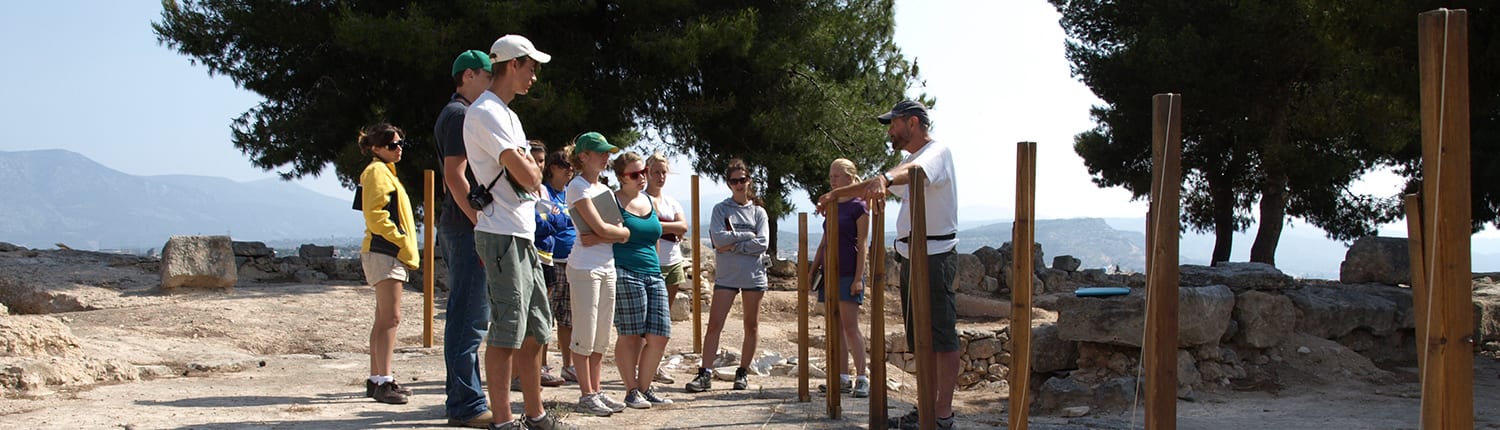
Fieldwork at Isthmia
Over the past two
decades, The Ohio State University has been involved in numerous archaeological
projects in the region of the Korinthia, every summer attracting scholars
and students from around the world. Several monographs and many articles
have been published about these endeavors, while a few other areas are
currently being published or are under study. Although the Excavations
at Isthmia is the largest and longest running of these projects, OSU has
also been involved in other small-scale excavations as well as several
significant surveys. Each of these undertakings requires collaboration
with other institutions, numerous archaeologists, and specialists in geology,
geomorphology, statistics, map work, museum studies, computers, GIS, botany,
faunal analysis, osteology, and architecture. This section will examine
some of Ohio State's past and current archaeological projects.
Excavations
at Isthmia
As
discussed in the previous section, Isthmia was a large Panhellenic
sanctuary dedicated to the worship of Poseidon. At different times
in its history, it was the home of great temples, racetracks,
cult caves, theatre, pool, Bath, fortress, houses, and even major
defensive works. During Greco-Roman times, its games every two
years attracted visitors from across the Greek-speaking world
(Figure 6.1). In the Late Roman period, the building material
from the site was used to construct the Hexamilion Wall, the defensive
fortification that stretched across the Isthmus, defending the
Peloponnesos against attack from northern Greece. The complexity
of such a history has been corroborated over the past half century
through the near-continual fieldwork at the site, beginning in
the 1950s, under the sponsorship of the University of Chicago.
Yet, despite all the work that has gone on, much of the site still
remains unexplored. Most of the athletic buildings, for example,
which must have existed in the Classical and Roman periods, have
simply not been found. Further excavations are needed to illuminate
the history of the site.
Fieldwork
at Isthmia is presently under the direction of the University
of Chicago and The Ohio State University. The former, under the
direction of Elizabeth R. Gebhard, is responsible for the central
part of the Sanctuary, while OSU excavations, since 1987 under
the direction of Timothy E. Gregory, have focused on the Roman
Bath, the Byzantine Fortifications, the West Cemetery, and the
East Field. Currently, the Excavations at Isthmia is the largest
of OSU's projects, and many areas of the site, including the Byzantine
Fortress and the Roman Bath, have been or are currently being
published, while other areas are still under study.
The
Roman Bath
Excavations
of the Roman Bath at Isthmia have uncovered an enormous complex
with a long and variable history. The Roman Bath was built in
the mid-second century AD on the foundation of an earlier Greek
pool that dates back to at least the fourth century BC (Figure
6.2). Archaeological remains have shown that the bath continued
in use until its abandonment in the late fourth century AD, after
which it fell into decay and finally collapsed in the late sixth
century. Pottery, walls, hearths, and cement floors suggest activities
continued in this area during the Byzantine seventh and eighth
centuries.
After it collapsed
the Bath was covered by centuries of deposits and only discovered in modern
times. By the time the traveler William Leake visited the area in the
early 1800s, only one arch on the northern end protruded from the surface
to give any clue of the structure that lay buried beneath; that traveler
thought the bath was a small fortress connected with the Isthmian wall.
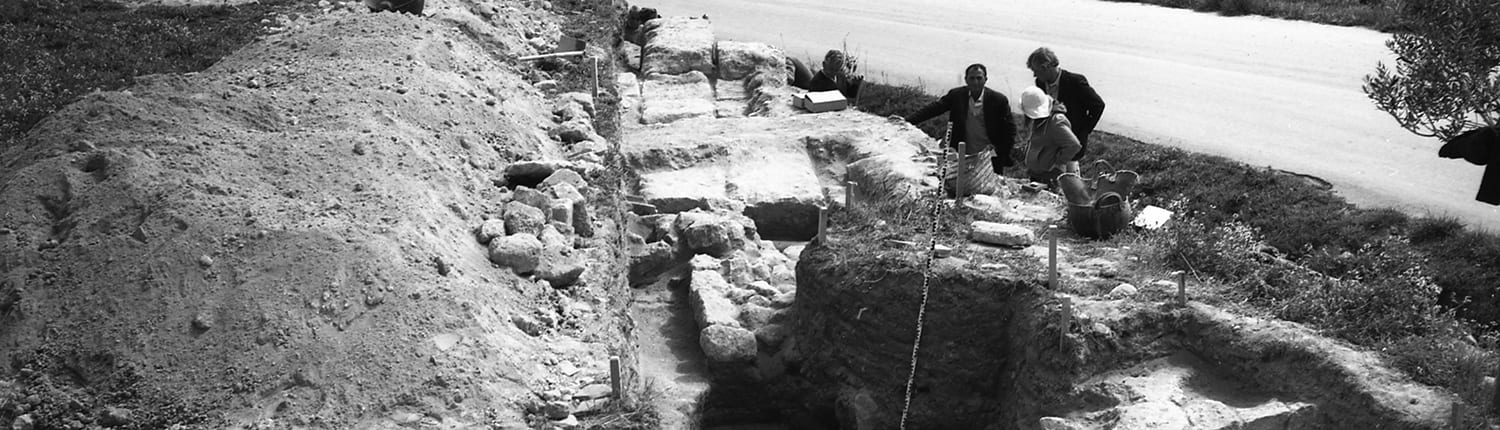
It was not until 1954 that the complex was investigated archaeologically.
In that year, Oscar Broneer of the University of Chicago placed a small
trench at the southern end of the bath, revealing parts of Rooms XI and
XIII. From the hypocausts and glass fragments uncovered in those rooms,
he correctly identified it as bathing establishment of the Roman period
that merited further investigation. Most of this investigation was carried
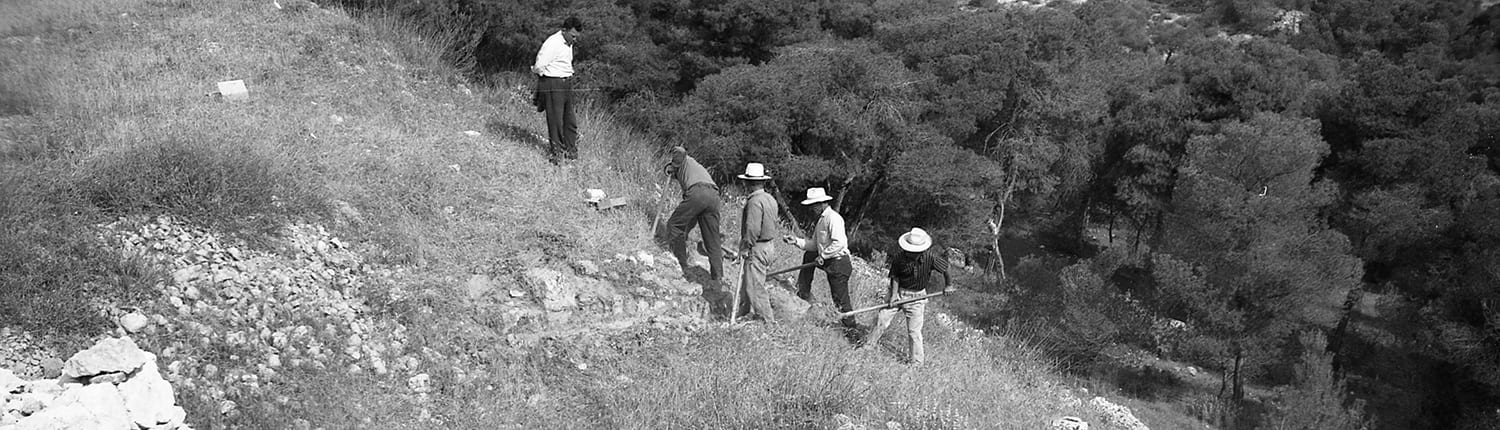
out between 1972 and 1980 by Paul Clement of UCLA. The pace of excavation
was amazing. In the first major field season, 1972, Clement's crews uncovered
the entire northern third of the bath, clearing Rooms I to V, sometimes
to the depth of up to three meters. In only four field seasons, between
1972 and 1978, excavators were able to define the plan of the entire Roman
Bath. The Ohio State University became responsible for fieldwork at the
bath beginning in 1987. There followed additional small-scale explorations
and a major effort to conserve the architecture and especially the monochrome
mosaic in Room VI.
Roman
Bathing at Isthmia: Bathing in Roman times was a drawn-out
social event, potentially lasting several hours and involving
a trip through the complex. The entrance to the Roman Bath at
Isthmia was probably either in the north, through Room I or in
the south through Room XII (Figure 6.3). After entering the building,
the Bather would have proceeded to change in Rooms I, II or VIII.
Individuals would then have proceeded to the most decorative Room
VI, the famous mosaic room. This was the main gathering hall of
the structure and where much conversation and socializing would
have taken place. After conversing with friends, the Bather might
have gone on to the caldarium (hot room, Rooms XI and XIII), to
the tepidarium (warm room, Rooms IX and X), and then to the frigidarium
(cold rooms, Rooms III-V), to take a dip in the cool plunge pools.
After spending some time there, the Bather might have exited in
the same place from which he entered. Alternatively, the Bather
might have reversed this order, or spent all of his time in one
of the rooms. Unfortunately, we do not know who used the Bath
- whether its furnaces were fired only during the festival (every
two years) - and whether athletes used the Bath as part of their
training and relaxation. Were women allowed to Bathe in the building?
Unfortunately there is presently no clear evidence one way or
another.
Room
VI: Room VI is the most prominent and central room of the
Roman Bath at Isthmia and the main gathering place for visiting
Bathers. Besides being the largest room in the building, it also
was the most elaborately decorated, complete with a large monochrome
mosaic and a colossal sculptural group on a large base along the
west wall. The mosaic, together with the statue base and sculpture
fragments, clearly identifies Room VI as the great hall of the
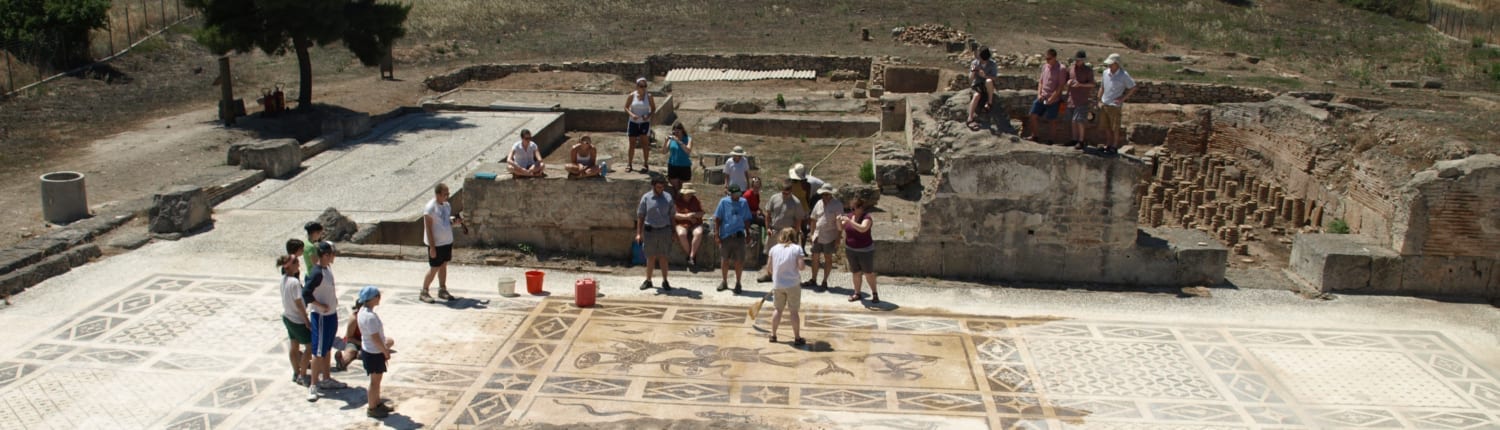
Roman Bath complex. The mosaic was monochrome, made up of many
small black and white tesserae, tiny stone cubes that were placed
together in a variety of designs and patterns. The eastern and
western thirds of the mosaic are decorated with geometric patterns
and the border of the mosaic is composed of square and rectangular
panels containing dolphins, flowers, and crosslets; the large
central panels are mirror-images of themselves, depicting Tritons
with Nereids on their backs, surrounded by various sea creatures
(Figure 6.4). These powerful scenes are known as a "marine thiasos"
and is probably connected with the worship of the god Dionysus.
This is the largest monochrome mosaic in the eastern Mediterranean,
measuring approximately 20 meters by 8 meters.
The Frigidarium:
Rooms III, IV, and V together constitute the complex known as
the frigidarium (the cold room). Room III, which was a small hall
lined with cut marble slabs and perhaps also decorated with statues
and paintings, was the entranceway to the cold Bathing. It led
down by three stairs to Rooms IV and V, the cold plunge pools
where one would actually be able to get into the water. The floors
and walls of these pools were also lined with marble slabs, evident
by the setting lines in the cement. The slabs on the wall rose
to a height of 1.30 meter, probably the height of the water in
the pools; painted floral patterns decorated the plaster wall
above this level.
The
Tepidaria and Caldaria: Rooms IX, X, XI, and XIII were all
heated spaces, each warmed by one or more furnaces. Beyond the
furnaces and under the floor was a sophisticated system called
hypocausts. The hypocaust system was made of piers of stacked
clay disks that may at first seem puzzling to someone unfamiliar
with Roman baths, visible in all these rooms still today (Figure
6.5). The round and square tiles (approximately .30m in diameter)
were stacked one-and-a-half meters high on a cement sub-floor
and were covered over with mortar, large square tiles, and nicely
cut marble slabs, forming the floor of those rooms. Thus, what
we see in these rooms today is not the floor, but actually the
sub-floor hypocaust area. Furnaces were located to the south of
Rooms IX, XI, on the north and south sides of Room XIII, and north
of Room X. As the fire blazed underneath, the hypocausts were
sufficiently warmed to heat up the entire room above, much like
a modern sauna, and the smoke escaped through numerous flues in
the wall, providing effective heating for the whole room. Indeed,
the furnaces extended also beneath the rectangular pools on the
northern and southern ends of Room XIII and the apsidal pool on
the south end of Room XI; these areas provided heated water for
those who wished to have warm baths. Since furnaces lie directly
under pools in Rooms XI and XIII, it is assumed that these were
"hot rooms" or caldaria, while Room IX was a "warm room" or tepidarium.
Room X might have been a "heat lock," a transitional space between
the hot and the cold rooms. The service area of the Bath lay along
the southern end of Rooms VIII, IX, XI, and XIII and Room XIV
itself, an enclosed area totally invisible from both inside and
outside the Bath. From here, slaves would have gathered wood to
stoke the furnaces. The height of the hypocausts above the lower
floor provided just enough room for children or small adults to
crawl beneath the floors and stoke a fire to heat the room.
Water Supply:
The Roman Bath at Isthmia required enormous quantities of fresh
water for its use. Indeed, the primary characteristics of Baths
in general were the wealth and luxuriousness of their size and
decoration, as well as ample supplies of water - an expensive
and precious commodity in all periods. Presumably, the water must
have been brought into the building under pressure and one or
more decorative fountains probably decorated the interior of the
Bath. Fortunately, there was an ample supply of water in the vicinity,
located several hundred meters to the southwest. Presumably the
water was brought to the Bath in one or more (probably above ground)
aqueducts, but no trace of these has been found. The water may
have been stored in tanks, perhaps even on the roof of the building,
and one or more reservoirs discovered on higher ground south of
the Bath may also have stored water for it.
Drainage:
Pools and baths depend upon a constant supply of fresh water and
thus a sophisticated drainage system is a necessary part of any
working bath. The drainage system of the Roman Bath, which was
largely explored during the 1976 field season, was well preserved.
Horizontal drains, constructed of large rectangular blocks and
covered with waterproof cement, were found in Rooms I, III, VI,
and IX, all emptying into a vertical drain in the southwest corner
of Room II. Two of the drains were purposefully blocked with large
stones in Late Antiquity and converted into a tomb; three skeletons
were found, probably representing individuals who defended the
Hexamilion Wall. In several modern experiments, the drains still
worked sufficiently well after 2000 years. The drains in the Roman
Baths at Isthmia were kept clear until AD 400 when they became
filled with objects such as coins and pottery, both of which are
used by archaeologists to date the clogging of the drain.
Decoration:
The entire interior of the Roman Bath at Isthmia was lavishly
decorated. The ceiling consisted of barrel vaults, which would
have towered majestically above floors covered with marble slabs
or mosaics. Although Room VI certainly contained the largest mosaic,
other rooms of the bath (I, II, VII. and probably VIII), also
had unpatterned mosaics, with tesserae of various colors: white,
pale gray, yellow, pink, and orange. Bath walls were adorned with
variegated marbles, decorated plasters, and architectural moldings.
Excavations also produced a variety capitals, such as those found
in Room IX, one with palmette decoration (IA 77-28), the other
with dolphin and trident (IA 77-1). Additionally, some sculpture
was also recovered, most notably the life-size portrait of Polydeukion
(IS 78-12) found just south of the Bath. Statues also would certainly
have stood at one or perhaps both ends of Room VI, as evidenced
by the several giant statue bases and colossal statue fragments.
The
Restoration of the Monochrome Mosaic
The
monochrome mosaic in Room VI was unearthed in 1976, in relatively
good condition but cracking in several spots and sunk as much
as 0.30 meters below the original surface; the unearthing of the
mosaic and subsequent exposure to the elements led to further
deterioration (Figure 6.6). At the outset, it was obvious that
the mosaic would have to be restored if it were to remain for
posterity, and indeed Paul Clement initiated this process in 1980;
however, full-scale restoration did not really begin for another
ten years, this time under the direction of The Ohio State University.
In 1990, the Ohio State University in cooperation with the Department
of Conservation of the Greek Ministry of Culture, began an expensive
and time-consuming conservation process: lifting the mosaic from
its current foundation, piecing it back together, and then resetting
it in place on a new, stronger concrete foundation. This work
was generously supported by the David and Lucille Packard Foundation
and the Samuel H. Kress Foundation. There are generally two ways
of removing mosaics for restoration: 1) the "sectional" method,
which cuts the mosaics into sections and then removes the parts
separately; and 2) the "rolling" method, which rolls up the mosaic
like a layer of carpet. Because the mosaic at Isthmia was already
broken in spots, Isthmia staff opted for the sectional method,
cutting the mosaic into rectangular panels (approximately 1.0
m. by 0.70 m.). After the entire mosaic was documented, mapped,
and photographed, and the mosaic was washed clean of dirt particles,
individual sections were then "chiseled" out, two layers of cloth
were glued to the surface of the sections to keep the tesserae
in place, and long iron bars were wedged through the mortar underneath
the panels and then pried up, removing the panel from the rest
of the mosaic.
Each
section lifted from its context was restored, the tesserae scrubbed
and cleaned of the ancient mortar. The 148 sections from the mosaic
were stored in a shed on the site. Once the whole mosaic had been
removed, excavation was conducted below the level of mosaic floor.
Besides uncovering a Roman level of fill intended to raise the
room to the desired level of the Bath, investigation also revealed
further evidences of the Greek pool. More importantly, the ceramics
found in the fill below the sealed mosaic floor date the fill
(and consequently, the mosaic floor) to the mid-second century.
This provides a construction date of about 150-170 AD. Following
the excavation of the fill, the area under the mosaic was refilled
with the original soil intermixed with modern debris and coins.
The seemingly bizarre activity of placing modern material in an
excavated context is actually commonplace in archaeological excavations
as a way of ensuring that future archaeologists will realize that
this area had been excavated. After the pool had been refilled,
archaeologists sealed it with a fresh layer of concrete and laid
the 148 mosaic panels back in place, an arduous process that took
over four years (Figure 6.7).
The
Greek Pool
One
of the major surprises of the excavations of the Roman Bath
was
the uncovering of an earlier Greek pool, first discovered when
excavations penetrated below level of the Roman construction
(Figure 6.8). The pool is at a slightly different orientation
from the Roman
Bath structure. The construction of the pool dates
to the fourth century BC and represents one of the largest Greek
bathing facilities known. With a depth of about one meter and
walls approximately 100 Greek feet in length (a Greek foot
= 0.320
m.), the pool was able to hold 1,275 cubic meters of water, suggesting
a sizable feature at the Sanctuary of Poseidon. The Greek pool
was lined with a solid waterproof cement with excellent capacities
for holding water, and indeed, following excavation, a rain
storm
left a pool of water that did not seep through the floors and
walls; only the 2500 year old drain took the water away.
There were at two
phases of construction during the Greek period, the latter dating to the
fourth century BC. Excavations revealed an even earlier Greek water device
(perhaps an earlier pool) beneath Room III, although little is known about
this first phase. When it was excavated, the floor of the Greek pool was
covered only with the soil dumped in by the Roman builders, suggesting
that the Romans had probably been using the Greek pool, taking advantage
of what already existed on the site. They later built the Roman Bath complex
directly on the Greek foundation.
The
Roman Bath Area today
Fieldwork at the
Roman Bath continues today at a slow pace. Excavation has not occurred
during the last several seasons. The main thrust of restoring the mosaic
is now complete. However, in the last several seasons, minor conservation
work has continued, as many loose tesserae still need to be chiseled,
cleaned, and placed back into the mosaic. More importantly, during
this
time the Ohio State University Excavations at Isthmia has been seeking
permission from the Greek authorities to construct a roof over the
mosaic and
to develop
an
overall conservation
plan that will call, not only for protection of the building, but also
for its use as a significant cultural center. This is an important
step
in the preservation of the site since it protects against the heavy winter
rains and the constant glare of the summer sun, ensuring that the
Mediterranean's
largest monochrome mosaic will see many future days, while making the
building accessible to visitors with differing interests.
The Roman
Bath is today at the point of publication. Although the Bath remains
partially unexcavated on the west side, and the area immediately
outside the Bath is largely unexplored, the overall plan is sufficiently
known that the results can be published. The forthcoming publication
will include chapters on various aspects of the Bath: decoration,
architecture and drainage, pottery, and lamps. After nearly a
half century of archaeological fieldwork, the life of this magnificent
building soon will be made available for everyone's enjoyment.
The
East Field
The
enigmatic East Field lies fifty meters east of the Temple of Poseidon
and south of the theater. It is an area that is only partly excavated
that demands future analysis and publication. Excavation in this
area revealed a series of multiperiod, small structures, with
poorly constructed walls set at various orientations (Figure 6.9).
That the walls probably represent houses or living quarters is
suggested by the water facilities and food preparation areas.
It is especially surprising that these small buildings would be
located right at the entrance to the Sanctuary. Although most
of the archaeological remains are from third century AD in date,
the site was obviously used for a long period of time, which party
explains its intricacy. Indeed, the East Field is an excellent
example of how complex archaeological excavation and analysis
can be. Conclusions regarding the purpose and history of the area
will only come with further study of the artifacts and excavation
records, and for this reason, the East Field will continue to
play an important part of future field seasons at Isthmia.
The
Hexamilion and the Byzantine Fortress
A massive
fortification wall runs along the northern side of the Roman Bath.
This fortified wall is known as the Hexamilion ("6-mile") Wall,
because it runs nearly six miles across the entire Isthmus of
Korinth, from the Korinthian to the Saronic Gulf, defending the
Peloponnessos (southern Greece) from invasions coming from the
North. Because this area of the Isthmus is very narrow, several
attempts to construct a wall here were made before the Byzantine
period. However, only the fortification of the Isthmus in the
fifth century AD, during the reign of Theodosius II (AD 408-450),
was successfully achieved. This wall was constructed of large
ashlar (squared) masonry blocks, mortar, and rubble, and it was
intended to prevent Visigoth invaders from penetrating the area.
Many parts of it still survive today.
The Byzantine
Fortress, which lies 150 meters to the east of the Roman Bath
and projects southward from the Hexamilion Wall, also dates to
the fifth century. The Fortress incorporated a Roman monumental
arch into its Northeast Gate, and this would have marked the grand
entrance to the Sanctuary and the Fortress, and perhaps the Peloponnesos
as a whole. Excavation in the northern areas of the Fortress uncovered
many graves, sometimes containing several burials. Although archaeologists
expected that the individuals buried in the Fortress would all
have been soldiers, many were women and children -- suggesting
that families lived within the Fortress and that life continued
in the Fortress even in times of peace. Like the Hexamilion Wall,
the Fortress was certainly used and refurbished after the fifth
century, during the later Byzantine, Frankish, and Venetian periods,
at least until the 17th century AD.
The
Hexamilion and the Fortress are continued points of interest and
study for OSU Excavations at Isthmia. Recent work has centered
on recording the numerous spolia (reused blocks) used as construction
material in the Wall and Fortress (Figure 6.10). During the fifth
century AD, when the fortifications were being constructed, the
builders made use of the ready supply of cut stone and marble
that had originally been part of temple, Bath, theatre, and athletic
structures, but had since fallen into disuse. The study of the
spolia has focused on locating, identifying, and recording blocks
that originated from the structures at Isthmia. This project is
ongoing and expected to continue in the immediate future.
|