
|
The
Roman Bath
The Roman Bath
was built in the mid-second century AD. Archaeological remains have
shown that the bath continued in use until its abandonment in the
late fourth century AD, after which it fell into decay and finally
collapsed in the late sixth century. Pottery, walls, hearths, and
cement floors suggest activities continued in this area during the
Byzantine seventh and eighth centuries.
The
Roman Bath at Isthmia
The Roman Bath
was an elaborate structure, with vaulted ceilings, numerous sculptures,
and marble dressed walls; however, the most dominating feature in
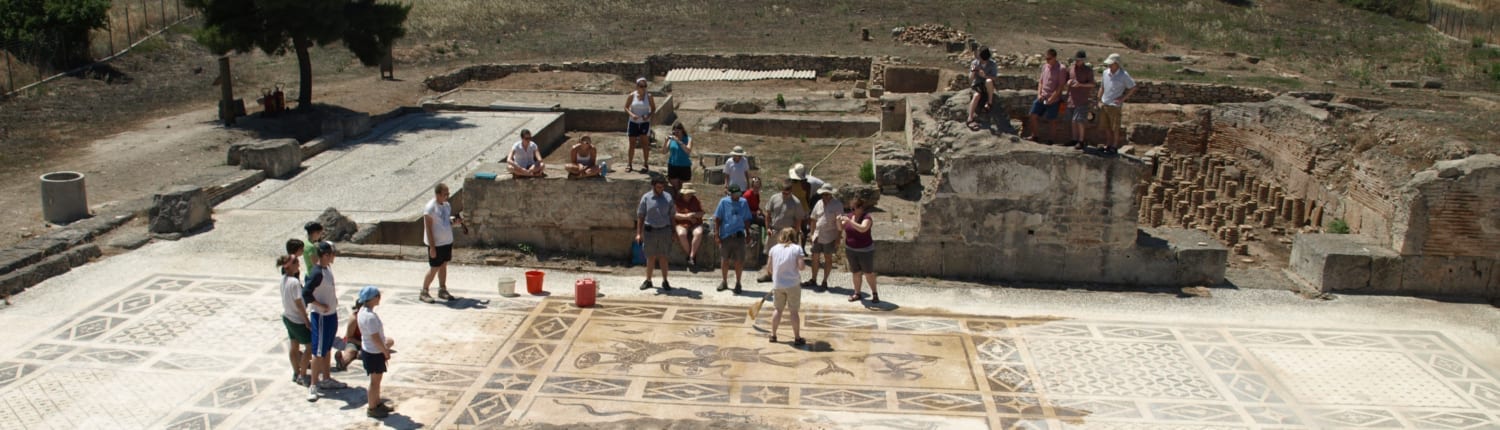
the Roman Bath area is the Italian style monochrome mosaic found
in room VI. The mosaic, accompanied by the colossal statue bases
and remnants of sculpture, clearly identifies room VI as the great
hall of the Roman Bath complex.
Bathing in Roman
times was a lengthy and social event, lasting several hours and
involving a trip through most of complex, including both the caldarium
and frigidarium. The bather would have entered the bath through
either rooms I or XII, and changed in rooms I, II or VII. Individuals
using the bath could then have proceeded into room VI, the mosaic
room. This was the main gathering hall of the structure, and this
is where a majority of conversation and socializing would have taken
place.
Central
panel of monochrome mosaic in room VI
The mosaic consisted
of many small black and white tesserae which, when placed together
in the correct order, formed many different designs. The eastern
and western thirds of the mosaic are decorated with geometric patterns
and the border of the mosaic is composed of square and rectangular
panels containing dolphins, flowers, and crosslets; the large central
panels are mirror-images of themselves, depicting Tritons with Nereids
on their backs, surrounded by various sea creatures. This is the
largest monochrome mosaic in the eastern Mediterranean, measuring
approximately 20 meters by 8 meters.
The rest of
the bath, was actually used for bathing purposes. The frigidarium
(rooms III-V) held cool plunge pools. The caldarium (rooms IX,XI,
and XIII) were heated rooms with warm pools. Room X served as a
heat-lock between the caldarium and frigidarium, a kind of "warm
room" between these two sections of the bath complex. These heated
rooms were each warmed by one or more furnaces, and a sophisticated
system of hypocausts supported their floors. The hypocausts were
made of piers of stacked clay disks (approximately
.30m in diameter) that were stacked one-and-a-half meters high,
and were covered with mortar, large square tiles, and nicely cut
marble slabs, forming the floor of these rooms. Furnaces were located
to the south of Rooms IX and XI, west of Room XIII, and north of
Room X. From these furnaces, the hypocausts were sufficiently warmed
to heat up the entire room above. The smoke escaped through numerous
flues in the wall, providing effective heating for the whole room.
Plan
of Roman Bath
The Roman Bath
at Isthmia required enormous quantities of fresh water for its use.
There was an ample supply of water in the vicinity, located several
hundred meters to the southwest. Presumably, the water was brought
to the Bath by aqueduct, but no trace of these has been found. The
water may have been stored in tanks, perhaps even on the roof of
the building, and one or more reservoirs discovered on higher ground
south of the Bath may also have stored water for it.
In addition
to a readily available water supply, a sophisticated drainage system
is also a necessary part of any working bath. Horizontal drains,
constructed of large rectangular blocks and covered with waterproof
cement, were found in Rooms I, III, VI, and IX, all emptying into
a vertical drain in the southwest corner of Room II. In several
modern experiments, the drains still worked sufficiently after 2000
years. The drains in the Roman Baths at Isthmia were kept clear
until AD 400 when they became filled with objects such as coins
and pottery, both of which are used by archaeologists to date the
clogging of the drain.
The Roman Bath
was built over a Greek structure of a similar nature; and the restoration
of the monochrome mosaic in room VI allowed for a closer inspection
of the Greek pool, partially located
beneath the area of the mosaic.
|