
|
The
Sanctuary to Poseidon at Isthmia
The ancient
site of Isthmia was a religious sanctuary dedicated to Poseidon,
and administered by the city-state of Korinth. Isthmia, along with
Olympia, Delphi, and Nemea made up the four Panhellenic Sanctuaries.
Panhellenic sites were revered by all Greeks, not just those local
to the site.
As one of Four
Panhellenic Sanctuaries, Isthmia had special importance in the Greek
and Roman periods. Its athletic and religious festival was second
in importance only to Olympia. The traditional date of the founding
of the Isthmian Games is 584 BC. Every two years, the Isthmian games
took place, and contestants from all over Greece would travel to
the sanctuary at Isthmia to participate. Athletic contests took
place at the games along with drama and poetry competitions. Originally,
these competitions held great religious significance; however, as
time passed they came to acquire a more secular nature. Although
the games at Olympia and Delphi were perhaps more well-known, the
site at Isthmia drew many famous visitors including, Alexander the
Great, the apostle Paul, and the Roman emperor Nero. Part of that
importance was a direct result of Isthmia's important geographic
location.
The
location of Isthmia in Greece
In antiquity,
the Isthmian sanctuary of Poseidon was established near the ancient
road between Athens and Korinth, two of the largest and wealthiest
cities in Classical Greek times. This gave Isthmia a very central
location which would have attracted travelers between the two major
cities, as well as merchants or travelers crossing the isthmus.
It is safe to say that the site would certainly have attracted the
attention of most people traversing the area. This importance continued
into the Middle Ages when Isthmia became the main bastion in the
Byzantine defenses of southern Greece.
The isthmus
lies between the Korinthian Gulf to the west, and the Saronic Gulf
to the east. The Panhellenic site at Isthmia lies directly on the
Isthmus, near the Saronic Gulf.
A
Brief History of the Site:
A large Doric
temple to Poseidon was built at Isthmia around 700 BC. The site
at the Isthmus was a natural spot for the structure, since many
travelers passed through on land and there were many ports nearby
that served maritime traders. Both the temple and Isthmia prospered
because of the Isthmia Games. Around 480 BC the archaic temple was
destroyed by fire. A new, larger temple was constructed about 465,
and the games continued. Throughout the next decades there were
several conflicts in Greece but the games were held uninterruptedly.
However, in 390 the games were disrupted when a Spartan Army marched
on the Isthmus. The temple was damaged again by fire, and because
of economic trouble in Korinth, the damage took some time to repair.
Throughout most
of the third century the Macedonian kings used Korinth as one of
their most strategic garrisons. The Macedonians lost control over
Korinth in 243 BC to the Achaian league, but regained it in 228.
In 225-4 the Macedonians brought an army through the Isthmus to
face another Achaian force trying to take Korinth. Since the Isthmus
was the crossroads of Greece, armies would continue to march through
it, often with disastrous consequences to Isthmia and the Temple.
Rome arrived
in 200 BC to liberate Greece from Macedonian control; one of the
garrisons they took was Korinth. The war against the Macedonians
concluded in 196 with a complete Roman victory. Before withdrawing
his troops the Roman General Flamininus chose to make a political
statement and a demonstration of Roman goodwill: he would announce
the complete liberation of Greece. It should come as no surprise
that the place he chose to make this announcement was the Isthmian
games. By now Isthmia had had a long history as a symbol of Greek
freedom, Greek unity, and Greek resistance to outsiders.
Fifty years
later the Romans were less magnanimous to Greece. After declaring
war on the Achaian League, the General Mummius decided to make another
political statement in Korinth. In 144 BC Mummius ordered Korinth
to be destroyed. Isthmia was not spared. The Altar of Poseidon was
destroyed, and the Isthmian Games were transferred to the control
of Korinth's neighbor Sicyon. The games probably moved there too.
Korinth was later rebounded as a Roman Colony by Julius Caesar in
44BC, and the city-state regained control of the games about forty
years later; however archeological evidence suggests that the games
did not return to Isthmia until about 50 AD. At that time, the temple
and the facilities for the games were repaired, and in 67 AD the
Emperor Nero took part in the panhellenic games.
By the end of
the fourth century Christianity would be the only legal religion
in the Empire, and it is almost certain that no more games were
given in honor of Poseidon. By 400 the sanctuary to Poseidon was
an abandoned relic to a bygone era. In the reign of Theodosius II
a wall was constructed across the Isthmus. The Hexamilion (six-mile)
wall required an enormous quantity of stone to construct, and many
abandoned buildings were plundered for stone. The temple was torn
down to its foundations. Isthmia itself may have been sporadically
abandoned between the late 7th century and the 11th or 12th century
AD. However, the Isthmus continued to be an important strategic
location during the Late Medieval and Early Modern periods.
The
Sanctuary Today:
Isthmia is not
as immediately "appealing" as some other sites primarily
because it continued to be used intensively in the Middle Ages.
As a result, most of the architecture of the Sanctuary was stripped
from its original setting, and used in construction of the Hexamilion
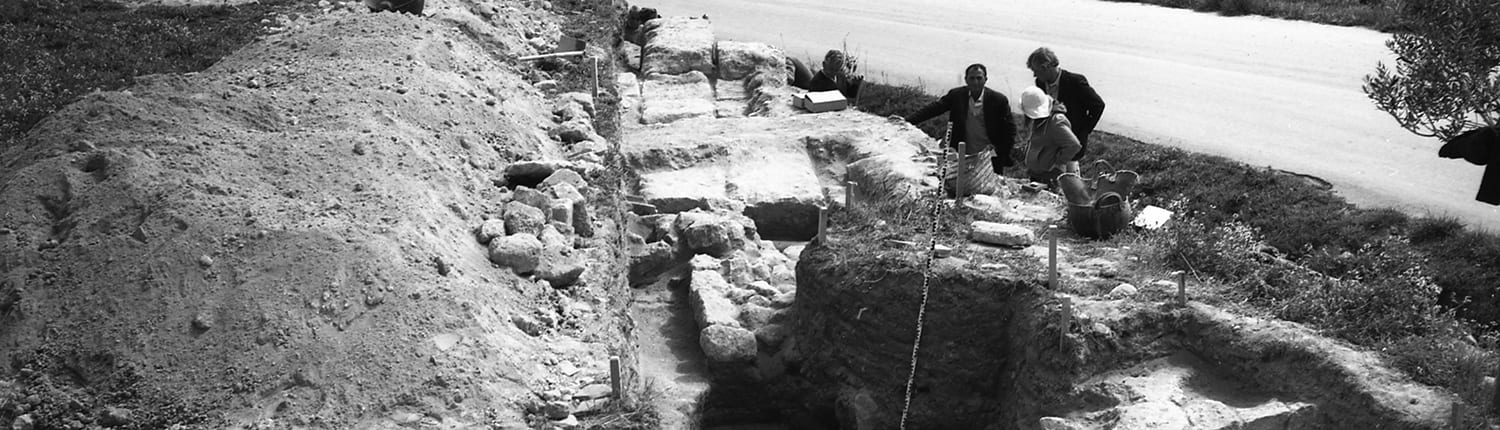
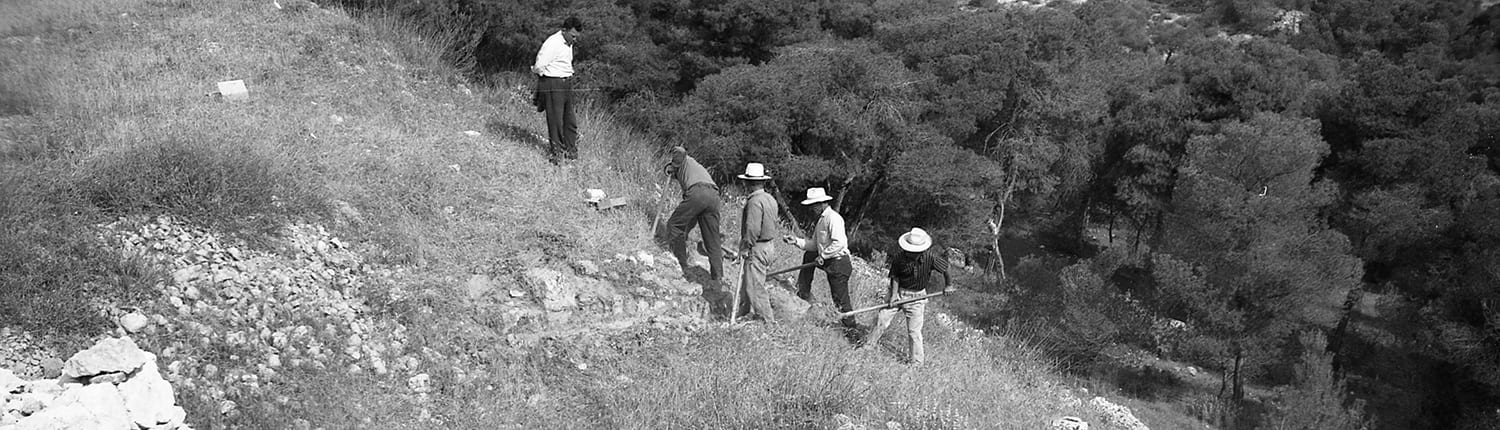
fortifications in the fifth century after Christ. The excavations
at Isthmia have taken place nearly continuously since the mid-1950's.
Work by teams from the University of Chicago has been responsible
for construction of a museum and maintenance of the central part
of the Sanctuary, while Ohio State has worked in the outlying areas
of the site, including the Roman Bath and the East Field.

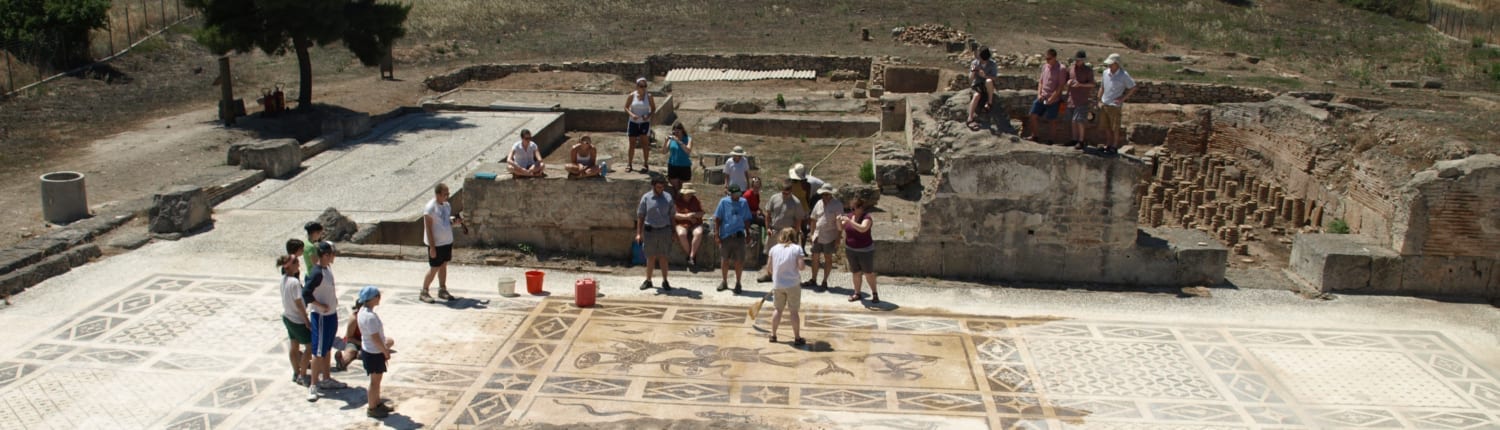
Conservation
of the monochrome mosaic, summer 1995
Although Isthmia
was an important athletic center, most of the athletic buildings
remain undiscovered today; of these, only the stadium (in three
separate phases) has so far been excavated. Most of the athletic
buildings that certainly existed at Isthmia remain unknown and unexplored.
Isthmia thus holds out the promise of providing new information
about sports in ancient times.
|