
BRIEF GUIDE TO THE KORINTHIA

ARCHAEOLOGICAL SITES:

 [Note that the erection of new brownish signs in 1999 has aided considerable in helping people find archaeological sites and museums.  The Ministry of Culture is to be commended for this action.]

  ANCIENT KORINTH -- the city

  [How to get there: you are living in the midst of the ancient city.  The streets on either side of the hotel both certainly trace the routes of their ancient predecessors.  To get to the excavations and the museum, go through the plateia; in the plateia you will see the ruins and the exit from the site.  Continue on for a short distance to the west (about 10 minutes from ROOMS MARINOS) to the entrance.  Follow the signs for "museum."]  

          Korinth was one of the greatest cities of the ancient world.  The city's location astride the waters of the Saronic and the Korinthian Gulfs, made Korinth an important commercial and industrial center, while the rich plain north of the city provided a secure economic base.  Although people lived here in prehistoric times, Korinth reached the height of its prosperity and power in the 7th and 6th centuries B.C., when Korinthian products were found in the marketplaces throughout the Mediterranean.

Korinth suffered from the rise of Athens but it was still one of the major powers of Greece in the 5th century.  The Macedonian kings regarded Korinth as the center of Greece and they founded the League of Korinth as the main political organization of the country.  The Romans regarded Korinth as the center of Greek independence and in 146 B.C. the Roman general Mummius utterly destroyed the city.  It remained desolate until Julius Caesar recognized the city's potential and re-founded it as a Roman colony.  Thereafter Korinth flourished as the capital of Roman Greece.  Its commerce was legendary and its places of pleasure earned for it a reputation of another kind.  The Apostle Paul visited the city and founded a church here; according to his correspondence, even the Christian Korinthians were not all well-behaved. 

At the end of antiquity Korinth suffered the fate of most Greek cities: it was sacked by barbarians and diminished in size.  Nevertheless, under the Byzantine emperors Korinth was still a commercial center, the seat of an important bishop, and capital of the Peloponnesos.  The city retained this standing under the Latins of the Fourth Crusade after 1205, and Akrokorinth became a western medieval castle.  After the Ottoman capture of the Byzantine Empire in the 1450's Korinth began to decline, although it remained a major port--the currents exported to the West were, of course, from Korinth.  In 1856 a devastating earthquake struck the city--one of many that have been recorded--and most of the inhabitants moved away to found New Korinth, leaving the village much as it is today.

The Excavations--Korinth has been excavated since 1896 by the American School of Classical Studies.  Current excavations are under the direction of Charles K. Williams II.  Excavation is carried out from mid-spring until the end of June, and study continues throughout the year.

Before entering the excavated area, to the north you will note the remains of the Odeon (small theater) and beyond that the site of the Theater where excavations are now in progress.  To the right you will see rows of houses along a major street that ran along the east side of the Theater.  These excavations are providing a new insight into living conditions in the ancient city as well as producing important new mosaics and frescoes.

As you enter the excavated area remember that what you see are mostly the remains of the Roman city, since Mummius destroyed the Greek city so thoroughly.  The remains are, however, so extensive that we can only make a few notes here and refer you to a full plan and detailed discussion of the monuments.

To the right of the museum are the stripped remains of Temple E, probably dedicated to the imperial cult.  The temple may have, in fact, been dedicated to Octavia, the sister of the empress Augustus as Venus; remember that Venus, or Aphrodite, was the patron deity of Korinth but also the ancestress of the imperial family of Rome.  The temple is in the Korinthian order and it stood high above the forum at the intersection of main streets, where it must have dominated this whole part of the city and the whole temple has been stripped of its marble decoration.  On the east end you should notice the traces of the staircase that led up to the podium. The columns you see on the podium are, of course, only a fraction of their original height. 

Straight beyond Temple E (to the south) you will see a roped-off area, where excavations have recently been completed, under the direction of Charles K. Williams II.  Do not enter the closed area (until it is officially opened to the public), but you may be able to see some of the work of excavation from a distance.  This was perhaps the center of the city during the Middle Ages, and excavation has revealed an important ecclesiastical complex of the Frankish period.  Recent work on the archaeology of the medieval period is revealing important, rich information about life in Korinth from ca. 1000 to 1500.

The museum is located just east of Temple E.  You should probably visit it now since the exit from the site is by another gate into the plateia.  The museum was robbed at Easter of 1990 and nearly 300 objects were stolen.  As you may have read, most of these have recently been found in Miami and it is hoped that they will all soon be returned to the museum

Inside the museum notice he plaque to the left of the entry hall that tells how and why the building was built.  The main rooms of the museum are arranged chronologically, with the “Greek” room on the right, and the Roman-Byzantine room on the left, with miscellaneous material in the courtyard straight ahead.  In the Greek room is an important display of the development of Korinthian pottery that demonstrates, among other things, the power of Korinth in the early Greek period. Particularly significant is the pottery from ca. 625 to 500 B.C., when Korinth took the lead in artistic and commercial development in Greece. You should also notice the display case showing moulds and other objects from ceramic manufacture, and the objects from the Asklepieion (healing sanctuary of the god Asklepios) on the right wall.

In the room on the left are the Roman imperial sculpture and mosaics, along with important material from the Middle Ages.  Near the entrance to the room is a series of sculpture representing various member of the family of Augustus, the first Roman emperor.  In the middle of the room are mosaics and frescoes from some of the wealthy private houses of the Roman period, and at the far end are two colossal statues of barbarians that had originally supported the lower story of the so-called Captive's Facade along the north side of the Roman forum.  They must certainly have commemorated an important victory of the Romans over their enemies the Parthians, and they attest to the power of Roman arms and the ways in which the Romans used propaganda.  From the Roman Room you should walk down the corridor toward the courtyard, past scenes depicting Herakles’ labors from the Theater, and go into the courtyard beyond.  In the courtyard is a group of headless togate statues, originally mass-produced with look-alike bodies and with heads that been originally cut to resemble the person depicted--the heads have since fallen off.  Don't stand on the statues for pictures the way uncultivated tourists sometimes do!  Ask a guard and he/she will open the Asklepieion room which has terra-cotta votives of various human parts, thank-offerings to the healing god, now kept locked for prudish reasons, although a few are currently on display.  Beyond the courtyard are the workrooms of the excavation (don't disturb!).

            Outside the museum, the view to the east commands the whole of the Roman forum, an enormous rectangle, all of it originally paved.  On the near side was a series of small temples, all on pedestals; on three sides and down the center were rows of shops, while on the far side were the offices of state.  In the midst must have milled the thousands of sailors, merchants, preachers, healers, thieves, and prostitutes who visited the city daily. 

Before visiting the forum, however, it is probably best to visit the remains of the Temple of Apollo, to the left.  This is one of the earliest surviving temples in Greece, built in the 6th century B.C., probably on the remains of a yet earlier temple.  Remember that you can see only the western end of the temple and that it continued far down to the east; also, the worn limestone blocks were once covered with bright white stucco.  The colonnades and walls of the temple can be traced in the cuttings made in the bedrock, even though most of the structure has vanished.  The temple was extraordinarily long (east-west) and it apparently had two distinct cellae (rooms that contained the cult statue), suggesting that perhaps the temple was dedicated to two separate deities.  The view from the temple to the south, over the whole of the forum, is quite spectacular.  Notice that the columns are constructed of single blocks of stone (monolithic) and that the stylobate (floor-level of the temple) is preserved only where the columns still stand on the blocks.  The columns standing today have been there since antiquity and they are shown in many drawings and early photographs of the area, commonly built into contemporary houses.

To the west of the Temple of Apollo notice the Fountain of Glauke, cut out of the living stone of an earlier hill (that is, the structure was not built up out of blocks, but rather "hollowed out" of the native bedrock). This is the site where--according to the mythological story-- one of the final scenes in the tragedy of Jason and Medea was played out: abandoned by Jason for Glauke, Medea gave her rival a magic cloak that caught the unfortunate Glauke on fire.  She then tried to quench the flame in the fountain that has since borne her name, but to no avail.

Back in the forum, notice the South Stoa that occupies the whole of the south side.  It is the largest non-religious building in Greece and one of the largest of any kind.  According to Oscar Broneer, who published the building, it was constructed as a kind of hotel by Alexander the Great or his father to house delegates to the League of Korinth (the organization through which the Macedonian kings ruled Greece).  In the Roman period it held shops and various city offices.  In the middle of the forum is a low rectangular structure identified as the bema, where the Apostle Paul was tried by the governor Gallio.  Modern research questions that identification, but crowds of Christians gather there daily for prayer. 

            Near the southeast corner of the forum a great road led out to the port at Lechaion.  This was once crowned by a triple-passageway monumental arch, surmounted by golden sculptures depicting the Sun and Phaethon.  To the east of the Lechaion Road is the Lower Peirene Fountain, whose waters can still be heard in the cool recesses beyond the facade.  Note the fading Roman frescoes on the walls and appreciate the importance of water in Mediterranean civilization.  Within the fountain you can see the water channels cut into the natural Corinthian clay bed; these were cut in antiquity to collect and bring the underground water to the fountain.  These can be followed for hundreds of meters under the ancient city (although you should not get into the channels yourself!). 

Along the Lechaion Road notice also the bases designed to hold statues of those who made important donations to the city and, on the right, a large public latrine: notice the seats, still reasonably well preserved and consider the ancient attitudes toward privacy!  On the other hand, you can see that the entrance into the latrine had a post in the middle of the doorway, suggesting that it was a "revolving" door.        

AKROKORINTH -- the citadel of Korinth

[How to get there:  You can't miss Akrokorinth since it is the height that dominates all of Ancient Korinth.  You can take a taxi or drive to the entrance of Akro (called locally simply the "kastro"--castle).  If you drive or walk take any road that runs directly toward the base of Akro and you'll eventually come to the Fountain of "Hadji Mustafa"; from there the road winds up to the west side of Akro and the entrance.  Until 1997 Akro was always open and there was no guard.  A gate has now been installed and there is a very conscientious guard; the site is open from early morning until about sunset and there  is no admission charge.  Visitors should be warned that there are many open holes opening up to deep cisterns, and much of the masonry is not secure, so considerable caution is urged.  There are also many wild animals and birds, including a considerable population of snakes, so again caution is advised.]

          Akrokorinth was the akropolis, the citadel, of the ancient city.  The walls of the city ran up its sides and the inhabitants could take refuge there in times of difficulty.  The walls now visible are primarily Byzantine and Venetian in date, but in many places one can see that these were built on the foundations of the classical walls.

            The present entrance is through a system of three gates, one inside the other.  The outermost of these is Venetian, but the other two were already part of the circuit in classical times.  The fortifications of the third (innermost) gate are most impressive; they are characterized by a wide arc punctuated by enormous towers from which the defenders could bombard any attacker; at every step of the approach the attacker would be at a disadvantage. 

            Beyond the third gate are the remains of a substantial town, now largely destroyed and overgrown; streets and some buildings, however, can still be made out.  During much of the Middle Ages this was the major settlement at Korinth and during the Ottoman occupation the Turks lived in Akrokorinth while Greeks inhabited the lower town.  Just past the gate are the remains of a mosque and above this the still-functioning church of St. George.  The artillery platforms above the gate afford a remarkable vista and further confirm the strength of the fortifications.

            Many visitors content themselves with seeing the area around the third gate.  Above this, however, is a deserted mosque, slowly falling into ruin, and well beyond this is the site of the Temple of Aphrodite, at the high point of the kastro, marked by a concrete column.  Only the ruins of the temple--which is said to have had 10,000 sacred prostitutes, although one has to wonder where they did their business!--are visible.  On the site are the remains of a Christian church and a large Frankish and Turkish tower.  Below the temple, to the south, is the Upper Peirene Fountain, and ancient spring house which can be visited by going down the stairs built by the American excavators: at the bottom of the stairs is a temple-type facade and there is almost always water in the fountain (don't drink the water!!  You will also find a flashlight handy for exploring the site).  Returning back toward the gates, you can visit the Frankish tower and keep, the highest part of the fortifications.  By climbing up through the high entrance and scrambling up to the roof of the tower you will have a spectacular view.  In addition, you will have the satisfaction of looking back from the plain below and seeing that you had reached the top of the tower.

            The best times to visit Akrokorinth are early in the morning or late in the afternoon; at mid-day the sun is frequently too intense for comfort even on cool days.  Sunset is a favorite time and one can look out across the fields to the north and the mountains to the west and be rewarded with a spectacular vista.  This must have been what the poet Angelos Sikilianos had in mind when he wrote a poem entitled

  ON AKROKORINTH

                                                The sun set over Akrokorinth

                                                burning the rock red.  From the sea

                                                a fragrant smell of seaweed now began

                                                to intoxicate my slender stallion.


                                                Foam on the bit, the white of his eye

                                                bared fully, he struggled to break

                                                my grip, tight on his reins,

                                                to leap free into open space.


                                                Was it the hour?  The rich odors?

                                                Was it the sea's deep saltiness?

                                                The forest's breathing far away?


                                                O had the etesian winds held strong

                                                a little longer, I would have gripped

                                                the reins and flanks of mythic Pegasus.


ISTHMIA -- Sanctuary of Poseidon and site of the Isthmian Games

[How to get there: Isthmia is about 12 km from Ancient Korinth.  By car the easiest route is to get on the National Highway going toward Athens, pass New Korinth, and turn off (south) on the first road toward Epidavros.  This road goes through the village of Kyras Vrysi, at the eastern end of which is the site and museum.  One can also go more directly, following the road in front of ROOMS MARINOS toward Argos.  At the traffic light go straight and then turn right on the road to Hexamilia; follow this road to Kyras Vrysi.  One can take a taxi to Isthmia for about 1500 drx or take a bus from Korinth (4-5 times a day) for 230 drx.]

          Isthmia was a religious sanctuary dedicated to Poseidon, god of the sea and of earthquakes.  Although it belonged to and was administered by Korinth, Isthmia was a Panhellenic Sanctuary, similar to Olympia and Delphi.  Every two years the Isthmian Games were celebrated at the site, with athletic contests and competitions involving music, drama, and poetry.  Although Olympia and Delphi were more famous, Isthmia probably attracted more visitors, including Alexander the Great, the Apostle Paul, and the emperor Nero.  During the Middle Ages Isthmia was transformed into a great fortress on the Hexamilion--the 6-mile-long wall across the Isthmus built to defend southern Greece from barbarian invasion.

            Isthmia is open from 9:00 to 3:00 (closed Mondays, although there have been problems with government budget cuts, and the site and museum have frequently remained closed completely for months at a time) and the entrance is free.  The site doesn't present a very spectacular appearance because its stones were so thoroughly robbed to build the Hexamilion at the end of antiquity.  It wasn't until 1952 that the exact site of the sanctuary was determined by the excavator, Oscar Broneer.  Today, one can trace the dimensions of the Temple of Poseidon by following the foundation cuttings in the broad flat area behind the museum.  The first temple, a long and narrow structure, was probably built in the 7th century B.C., but it was replaced by a classical temple constructed about the middle of the 5th century.  This, in turn, was damaged by fire in 390 B.C. and again following the Roman devastation of Korinth.  The building was certainly influential in the development of Doric architecture in classical Greece and it was one of the most important buildings in the Peloponnesos.

            During the Roman period the temple was surrounded on three sides by colonnades, and these can easily be traced out on the ground.  A piece of the superstructure can be seen in the northwest corner.  To the east of the temple are the foundations of a large altar, 100 feet long.  Beyond this toward the road is a sizable concrete and rubble rectangular foundation.  This has been identified as the Temple of Palaimon, the boy-hero who shared honors with Poseidon at Isthmia.  Through the middle of the foundation is a cutting, which would have been completely enclosed when the building was being used.  Broneer identified this as the underground passage where the athletes had to swear sacred oaths not to cheat during the games!

Just south of the Temple of Palaimon (toward the Temple of Poseidon) is a series of strange cuttings in the paving.  These are, in fact, part of the starting mechanism for the archaic stadium at Isthmia.  The runners lined up, each in his own lane, and an official stood in the hole behind, holding strings that ran through the cuttings to a gate device that he could open by pulling the strings.  The stadium was later rebuilt and then, finally, moved southeast across the modern highway to a natural defile.

            Beyond the temple area to the east is the Theater, which can still be visited although the path is often choked with weeds.  Particularly interesting are the "cult caves" at the top of the cavea where worshipers of Dionysus gathered for common meals.  The Theater is especially important since research by Elizabeth Gebhard has shown that it was a particularly early example and the orchestra was originally rectangular.  The Theater was rebuilt several times and in the Roman period the seats rose high above the modern ground level at the top of the concavity; only the supporting wing-walls are preserved to demonstrate this.

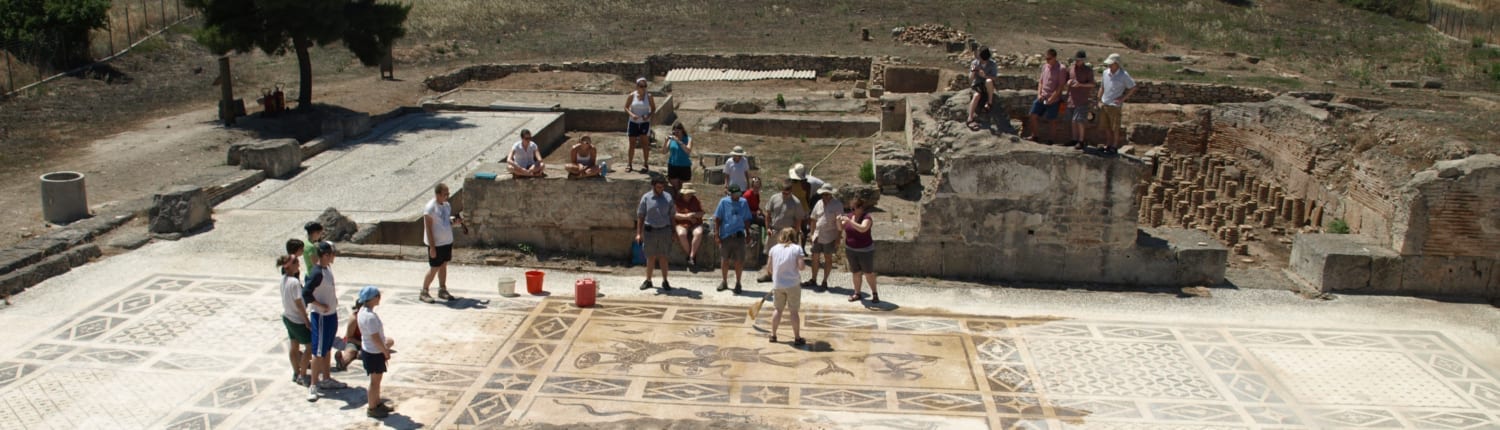
            Below the Theater is the Roman Bath, not presently open to visitors.  This was an important center of activity during the Roman period, and a spectacular Italian-type mosaic has been discovered on its floor, the largest of its kind in the eastern Mediterranean.  The mosaic had, as its central feature, representations of a woman riding on the back of a sea-creature; this is shown on the cover of this guide.  Recent research has shown that the Roman building was built on the remains of a Greek-period bath that had a pool 100 feet on a side, the largest ancient Greek swimming pool found to date.  The Ohio State University excavations are currently  focused on the Roman Bath, where we are carrying out the studies necessary for publication and we are carrying out an extensive conservation program in the Bath, including lifting, repair, and re-laying of the monochrome mosaic.

            By going down the main highway a little farther to the east and turning left at the first road, the visitor will come to the Fortress at Isthmia.  There is a modern church and cemetery in its midst, but the line of the walls and its numerous towers can still be traced.  From one of these it is possible to imagine the feelings of the defenders of the Hexamilion as they stood guard against the flood of barbarian invasion.

            The Museum at Isthmia contains finds from Isthmia and from near-by Kenchreai (see below).  Particularly impressive are the reconstruction of one of the lion's head spouts from the Temple of Poseidon (this gives a good idea of the size of the temple) and the victors' monuments on either side of the door to the left.  The one to the right is a monument to the Pithaules Lucius Kornelios Korinthos who won victories all over the ancient world (see the crowns that list his successes).  Both of these were found, turned upside down in the gateway to the Fortress; note the wheel ruts on the back!  In the main exhibit room see the archaic perirhanterion (water basin), the large (cult?) statue, athletic paraphernalia, and industrial equipment from a near-by dyeing establishment.  From Kenchreai you should see the spectacular glass panels, found in a warehouse where they had been stored, perhaps for installation in the Temple of Isis there.  There was an earthquake, the warehouse sank into the sea, and the panels remained until they were excavated recently.  The panels demonstrate a remarkable variety of scenes, from portraits of Plato and Homer to rich scenes of life along the Nile. 

            Special note to guests at ROOMS MARINOS:  Depending on our work schedule at Isthmia, it may be possible to arrange a brief tour of the site at Isthmia and--again depending on our schedule--we may be able to let you see the inner workings of the excavation itself.  Please contact one of the Isthmia staff members about this possibility.  


KENCHREAI-- Korinth's eastern port and an ideal spot for a picnic and a swim

[How to get there: By car simply follow the road to Isthmia further about 2 km along the coast.  Taxi from the Isthmus (taxi stand at the bridge) is easy, but by bus it is all but impossible to get to Kenchreai.]

          Korinth was ideally situated, with ports on two seas.  Kenchreai was Korinth's port on the Saronic Gulf, providing access to Athens and to the world of the East beyond.  Kenchreai is located on a beautiful natural harbor that was extended by the construction of breakwaters and docks that formed almost a full circle.  Excavations in the 1960's revealed buildings at the base of each of the breakwaters, to the north and the south.  To the south much of the excavation was conducted underwater, and here were discovered the glass panels mentioned above.  There was a temple of Isis (mentioned in Apuleius' ancient novel, The Golden Ass) and later a Christian church.  To the north the ruins are much less spectacular.  This peace of the setting is disturbed today only by the Greek families that descend on it for swimming, but once Kenchreai was one of the world's great emporia.  St. Paul departed for Palestine from Kenchreai after having his hair cut.             

You can swim right in the harbor itself (but watch out for the guard who is impolite to visitors who try to snorkel over the ruins!) or you can go just a few meters south to another, larger beach. 

LECHAION -- Korinth's harbor on the Gulf of Korinth

  [How to get there:  By car, drive straight down to the sea and turn left on the road toward Korinth; go under the underpass and take the second road to the left.  This goes directly to the sea.  By bus take the bus toward Korinth and get off immediately after the bus reaches the Korinth seaside road.  Walk about 10 minutes to the sea.  It is possible to walk to Lechaion from Ancient Korinth in about half an hour, but the traffic can be dangerous and it is often too hot.]

          Lechaion was Kenchreai's twin on the Gulf of Korinth, allowing trade with Italy, North Africa, and the whole of the West.  There has been little excavation at the site and only one major monument is visible.  Nevertheless, you can easily see the large mound of sand that breaks the flat expanse of beach here.  This is the debris dredged up when the inner harbor at Lechaion was built, probably in the early Roman era.  The harbor was equipped with circular breakwaters, as at Kenchreai, and the beginnings of these are still visible.  Just beyond the large mound you may be able to see the remains of the inner harbor, where ships could be brought in to avoid the dangerous storms of the Gulf and to provide further unloading space; in the winter and spring this harbor still has water. 

Just back from the sea where the road comes to an end there is a large fenced area.  This is the site of the Lechaion Basilica, the largest church discovered in Greece.  The fence is sometimes locked, but there are several holes in the fence and it is fairly easy to get in (remember, however, not to disturb the walls and paving, both of which are in very bad shape).  The basilica was built in two phases in the 5th and 6th centuries A.D. and it is over 200m long!  To the west is the atrium, in the center the narthex, and at the east the nave and sanctuary.  The church was divided into three aisles by columns and the central part probably had a dome of some sort.  To the north of the church is the baptistery.  Note especially the fine carving on the capitals and the other architectural sculpture.  The fine paving of the floor is sometimes visible, but please do not disturb this or sweep away the sand that has been placed there to protect it.

            Swimming right at the basilica itself is not recommended, but an excellent beach is just a few meters to the east, inside the ancient harbor.

PERACHORA -- Sanctuary of Hera

[How to get there: By car, drive to Loutraki and take the road to the village of Perachora and continue on to the west.  The road stops just above the sanctuary.  It's almost impossible to get to the Sanctuary of Hera by public transportation.  One can take a bus from Loutraki to Perachora village and walk beyond that, although this takes two hours each way.]

Perachora--"the land beyond"--is the tip of the narrow peninsula that dominates the view of the sea from Ancient Korinth.  The scenery and the views at Perachora are particularly spectacular and the water is clear and deep.  The modern village of Perachora is some km. to the east--and it was completely destroyed in the earthquake of 1981.  Just before reaching the Sanctuary of Hera is Lake Vouliagmene, a popular destination for Greek vacationers.  This nearly perfectly round lake once apparently had fresh water, but a canal was cut through to the sea (in antiquity) and the water is now salt. 

  Beyond Vouliagmene, the road winds through the ruins of ancient buildings (note a cistern and a spring house, and the walls of many ancient houses).  At the end of the road there is a lighthouse at the tip of the peninsula and today, just as in antiquity, Perachora is a major point in seaborne travel since it controls access into the whole of the Gulf.  From the area of the car-park or the lighthouse you can see Akrokorinth to the south and the coast of Central Greece (Boiotia) to the north.  From the Sanctuary below you can see directly through the Korinth Canal!!

  Because of Perachora's location, the Korinthians obviously had to control the site and prevent hostile powers from seizing it.  Perachora was particularly important in archaic times and it contains the remains of a temple of the 8th century B.C. overlooking the small harbor.  Below this is a large cistern to serve the many pilgrims who obviously frequented the spot.  By the sea are a stoa, an archaic altar, and the remains of another early temple.  The small finds, many of them dedications to the god, discovered at the site were particularly important and they include a model of a temple that is one of the oldest representations of architecture from classical Greece.  The Sanctuary was excavated by Humphrey Payne between 1930 and 1933, and a most interesting book by Payne's wife Dilys Powel, An Affair of the Heart, tells about the archaeologists' relationships with the people of the surrounding area.              

            Swimming is possible at the site and people often dive off the rocks, although there isn't much of a beach.  

THE DIOLKOS -- the ancient ship passage across the Isthmus

  [How to get there: By car drive to Korinth and take the road to toward Athens; after the road crosses the railroad and follows the tracks for a short distance it turns right and ascends--don't go that way, but continue straight ahead.  As the road reaches the canal stop and get out.  The Diolkos can be seen in cuttings on either side of the road, running parallel to the canal.  It's possible to get to the Diolkos cheaply by taxi from Korinth.]

          The sea passage around the tip of the Peloponnesos (around Cape Malea) was both costly and expensive.  Frequently it was cheaper to haul ships overland across the Isthmus of Korinth.  This was done on the Diolkos, a paved road that ran close to the course of the modern canal.  Excavations have revealed traces of the road here.  Just to the west, by the mouth of the canal, is a ship-shed cut into the rock.  

For other archaeological sites (Nemea, Sikyon, and the Argolid) see below.

Continue to next section of the Guide  

Go back to the beginning of the Guide   

OSU Isthmia website* Rooms Marinos* Rules and SOP Guide to the Korinthia

Excavation Procedures and Library Resources

Study Collection Excavation Projects Background on Ancient Korinth

Home